Auss-ie Ruling Class Musings on Penning People NOT being Punitive Conduct

Screenshot

Keypad Monkeys and GE/ CE/ CEPW/w, serving economic reform and systematically public-educating for the complete discard of Australian Council of Social Service policing, affective-empathy & disastrously antagonistic ‘How-do-you-feel?’ no-friendship social policy across the broad board since 1991 strongly recommend readers buy Anna Johnston’s book and also acquire ‘Far From a Low Gutter Girl’ re Adelaide and country town SA pre Federation – the days of Catherine Helen Spence, ‘speaking’ of the more than half-broken federation..

“Here I trace Maconochie’s connection to influential intellectuJoal networks and social reformers to examine how he used print and public testimony to shape the image of the Antipodean laboratory in the colonies and the imperial public sphere.

“Maconochie’s naval background and his wide-ranging intellectual interests positioned him uniquely to observe the workings of the penal system. Geographical and strategic curiosity, rather than any direct experience led to his proposal to annex the Sandwich Islands (later Hawai’i) as a British colony, and these traits underpinned his Summary View of the Statistics and Existing Commerce of the Principal Shores of the Pacific Ocean, etc. (1818), regarded as the first economic survey of the region. That substantial study was concerned to ‘fix public attention on the Pacific Ocean, that immense gap in our commercial relations:’ his statistical account sought to correct inadequate knowledge of the [quadrisphere’s] commercial and political resources. Maconochie’s intellectual connections with the Scottish and English Enlightenment and the admiralty ensured that he was among the founders and first office-holders of the Royal Geographical Society in 1830, which led to his appointment as first professor of geography at University College London .. Alison Alexander describes him as ‘an ambitious, self-confident theorist,’ and Maconochie’s career shows both the value and inherent risk when proponents of reform took metropolitan concepts into Antipodean practice. Eventually, Maconochie’s colonial methods were re-imported to Britain, [with questionable success but wide-ranging impact.]

“Maconochie claimed not to have preconceived ideas about penal systems, but he had speculated about the matter since 1818. Maconochie believed that the settlers in New South Wales were [ill-served by a penal system based on punishment] and exile rather than reform, casting [convictism] as a [violation] of settlers’ ‘civil rights as British subjects’ and a contamination of ‘their moral habits and feelings.’ Moreover, Maconochie was concerned that as long as it continued to be a penal colony, New South Wales could never become a ‘flourishing commercial establishment,’ which was the key to the linked port towns embedded in his Pacific vision. The fundamental principles of Maconochie’s penal reform were clear from the outset: prisoners’ positive actions should earn them marks through which they would earn their freedom from servitude, de-emphasising the time served under sentence. Prisoners would be grouped together in small family-sized [collectives] to reward them for behaviours based on [enlightened self-interest and social cohesion,] as opposed to the ‘separate system’ that [atomised] prisoners. So, too, Maconochie shrewdly made persuasive links to other pressing social matters: the secondary threat to mainstream (settler) society from the presence of unreformed prisoners, the moral degradation inherent in slavery that had recently been alleviated by abolition; and the economic and trade potential of [well-run] colonies with a properly mutual relationship to the imperial centre. ..”

That’s me done for major studies for Thu 11 Dec 2025

John Blundell

The two miracle goals of 1988 – Mount Barker and Milang – when you’re hot you’re hot

Channel 9 Crime-pranks People from Ashton & Stuff

You all knew that

WHERE sYDNEY cOVE hER lUCID BOSOM sWELLS

FROM The Antipodean Laboratory: Making Colonial Knowledge, 1770 – 1870, a 313 page ‘ancient’ razza authored by Anna Johnston of the University of Queensland: so Ladies I want you all to be on your best behaviour.. indeed, lend me some sugar: I am your neighbour

While with each breeze approaching vessels glide.\ And nothern treasures dance on every tide!

” ..the first Australian colony emerged from a sea of print. By September 1786, newspapers reported the British government’s decision to establish a colony at Botany Bay (or Norfolk Island), and both the London and provincial newspapers regularly commented as plans proceeded. Government efforts to establish the colony and the many motivations for colonisation are revealed in the late eighteenth-century record-keeping procedures of the British bureaucracy. There was also contention about its practicality. Convict transportation was a driver, given that the decision to establish a penal colony was made in the context of vigorous public debate about crime and punishment under the Pitt government after the disruption caused by the American Revolution, but the colony’s strategic value in the [Hemispheric or mega- “] region [] and the potential for the new settler colonies to support Britons were also key factors. One vision of the colony’s potential emerged in January 1787 in the King’s announcement at the opening of Parliament. Several newspapers reported that

‘.. It is an undertaking of humanity, for in all the islands of the South Seas, there is not a four-footed animal to be found but the hog, the dog and the rat, nor any of the grain of the other quarters of the world .. By the number of cattle now sending over of various sorts, and all the different seeds for vegetation, a capital improvement will be made in the southern part of the New World; and our ships, which may hereafter sail in that quarter of the globe, must receive refreshment in greater plenty than from the exhausted soil of Europe, consider that all New South Wales is formed of a virgin mould, undisturbed since the creation.’

Beyond convict transportation the benefits of agriculture and ‘capital improvement,’ and the promise of the Antipodean new world to refresh the European old world, were [troth prosaic,] ..pragmatic and metaphorical. In the configuration New South wales was the model for a modern English Enlightenment colony. Most notably, New South Wales provided a distinctive {SPACE] in which Anglophone Enlightenment ideas and evangelical Christianity coalesced3.

” .. So, too, was his metaphoric yoking together of imperial policy, natural history and the untested nature of penal reform in the colony.

” These visions of the new Australian colony – sometimes competing, sometimes mutually constitutive – were shaped and debated in popular print culture. Popularisations of Cook’s Endeavor voyage had created a market for colonial literature; pamphlets and stage performances featuring titillating accounts of Joseph Banks’s intimate exploits in Tahiti; drawings, woodcuts,, engravings, lithographs and vivid descriptions proliferated in the many books and collections devoted to the study of Southern natural history; and the popular genre of travel writing produced descriptions of people, places and environments, which circulated in newspapers as extracts and letters, as well as substantial bound volumes for the private libraries of elite book collectors. Publishers interested in marketing exoticism to British readers were matched by a rich public debate in print about legal and social reforms that addressed [DOMESTIC] crime and punishment problems3. So, too, the evangelical revival mobilised print to speculate and then report on the empire’s newest colony. Together, they produced a book market hungry for accounts of New South Wales even before it was established.

” .. ‘There the proud arch, Collossus-like, bestride

Yon glittering streams, and bound the chasing tide;

Embellished villas crown the landscaped scene,

Farms wave with gold, and orchards blush between.

There shall tall spires, and dome-capt towers ascend,

and piers and quays their massy structures blend ..’

” Hope’s departing edict – to conjoin peace, art and labour – set a lofty ambition for the colony. Wedgewood’s made with Sydney clay were sent back to New South Wales to demonstrate the manufacturing opportunities of colonial materials and served to show, metonymically, how these resources could be refined by European industry and stamped with high cultural aspirations.

” This Utopian discourse occluded the penal origins of Botany Bay and the dispossession of the Gadigal people of the Eora nation; yet it resonated with older antipodean ideas that accompanied Britain’s newest imperial acquisition. A piece in the Lady’s Magazine in 1791 prematurely depicted the colony as a tame landscape, managed by canals to enrich agriculture and the flow of trade and commerce: ‘a civil settlement and polite norms, overseen by an improving colonial projector, Governor Phillip,’ Dierdre Coleman notes. Others imagined the Australian colonies as sites for neoclassical ideals.”

Oh my goodness, Auss-ie readership. I would love to go on [Liar, Kevin], but I’ve already missed a huge chunk of the Brisbane, Sydney, and Melbourne railway commuters heading home for a well-earned.. Some Tuesday huh. Are there trains in Hobart?

Damn, now they’ve all gone home. My kingdom for a mass worldwide audience but y’know, a horse.. But the document’s nice. That’ll do us cranky professors of stuff OK.

Jonno

Adelaide Hills

Meat Pies, Kangaroos, and Hyundaes Yeh

Neurocognitive Health-education

Thematics Logic

1 Garvey, Nathan. Where Sydney Cove Her Lucid Bosom Swells: the Songs of an Imagined ‘Nation, ‘ 1786 – 1789. Literature Compass 4, no. 3 (2007): 599-609

2 Gascoigne, John. The Enlightenment and the Origins of European Australia. Cambridge: Cambridge University Press, 2002

3 Garvey, Nathan. Selling a Penal Colony: the Booksellers and Botany Bay. Script & Print 31, no. 1 (2007): 20-38

How About ..what-about?! East Prussia & Generals Samsonov & Rennenkampf

May all students of what actually happens in history at the ‘SHARP’ (THOUGH HIDDEN) decision-making end find the following useful

John

The Quartermaster-General of General Headquarters, Danilov, was third in rank in the Russian army, but foremost in initiative. He had spent the last few days diligently working out matters of prime importance: he had drawn up one plan for the speedy transformation of conquered East Prussia into a separate governor-generalship, and another for the immediate cessation of warlike operations there; the task of Rennenkampf’s army thus being completed, it would be moved forward across the Vistula for operations aimed at Berlin. As part of this plan he had asked North-Western Army Group to have one army transferred from Rennenkampf to Warsaw..

Since the Chief of Staff of North-Western Army Group, General Oranovsky, was in no position to protest at this directive (any objection made by a junior against an order from above always undermines hid status and prospects), he had already issued instructions for the corps in question to be pulled back to the railhead. (Rennenkampf.. ) Nor did Oranovsky dare, in reporting to his superiors, tolaymuch stress on the anxiety which was beginning to make itself felt among the staff of the North-West Army Group. He merely reported that X Corps had been force d to withdraw near Soldau in ‘a certain amount of disorder’, and that the two corps of von Francois and von Mackensen, ‘which have disappeared from the enemy forces facing Rennekampf’, had suddenly shown up in front of Second Army. But General headquarters was unperturbed by any of this, and in a long telephone conversation on the night of the 15th’/16th Danilov, in pursuit of his latest plan, induced Oranovsy to effect the immediate transfer of the Guards Corps from Warsaw to the Austrian front, remarking with complete unconcern that Samsonov would have to do without the Guards – he had nearly five corps anyway.

Zhilinsky and Oranovsky might have passed on some of the anxiety they felt that day by harrying Samsonov, but to their annoyance (and partly to their relief, because he would then be entirely to blame for anything that went wrong) Samsonov cut off communications. This absolved them of any responsibility for intervening directly to make Blagoveshchensky’s VI Corps and Artomonov’s former corps (I Corps) move inward to the aid of the centre corps of Second Army. To have done this would have been too much trouble to Army Group Headquarters; it would also have been beneath their dignity, [SINCE ACCORDING TO SERVICE PRACTICE THEY WERE NOT OBLIGED TO DO SO]..

Begin of Ch 41 August 15th pp 407-8 Aleksandr Solzhenitsyn trnsltd by Michael Glenny Penguin Books 1974

Now I greatly hope the foregoing excerpt from August 1914 serves all students of the contemporary “Romanov” – Misha Glenny – Russian situation with respect to western Europe well !

John Blundell

Australia

There follow student-purposed annotations – cognate ideational excursions concerning the year 1974

(i) 1974 was the year the USA Federal Bureau of Investigation murdered KAREN SILKWOOD, a nuclear power industry technician on behalf of the Robert Oppenheimer and the post WWII Science-boosterism cult¹ (and @WestinghouseNEC in a Billion-dollar promotional campaign at this present fraught time in human history)

(ii) as though there were an Intelligent Electronic Ambience² bringing all purposive and intellectually ‘powerful’ men and woman around the world to common and cognate experiences (even on the other side of the world) it was only weeks before Silkwood’s killing on a freeway outside Cleveland Ohio USA³ that having been selected by the SA government (when working for the Commonwealth Dept. of the Interior NTA Welfare Division in Alice Springs) to take up a District Officer position in what had been said to have been “the most racist town in Australia” on the front page of a city morning newspaper in 1973 I did that. – Followed by five virtually revolutionary years of service in that town by Australian or indeed ANY ex British colonial frontier zone standards.

¹”Oppenheimer and the Gita”
The phrase “Now I am become Death, the destroyer of worlds” from the Bhagavad Gita is a powerful statement by Lord Krishna, where he reveals his cosmic form to Arjuna. In this context, “Death” (Kala) represents not just physical death, but the ultimate power of time and change, encompassing creation, preservation, and destruction. It signifies Krishna’s role as the force that brings about the end of all things, ultimately leading to their recreation. This quote is famously associated with J. Robert Oppenheimer, who reflected on it after witnessing the first atomic bomb test at Los Alamos Nevada USA. ..this author’s supplied and far from gratuitous note appended at this point >> destroyer of THE world per the ecocidal and extreme unseasonal repetitive weather-systems failure onslaught of which nuclear radiation plays a signal part

²certainly an unproven social relations construct but equally certainly noted and briefly written up in my 1997 (post sting) Community Economist Publications Worldwide newsletter – JB

³”..killed in a car accident near Crescent, Oklahoma, north of Oklahoma City,” the spooks who want us all depersonalised as literal objects-of-trade for the profit of entrepreneurs and foreign investors particularly, if they can’t actually swing our dehumanisation for fertiliser NOW write..

Leading him the life of the damned. Wear the heart out of a stone, that. Monday morning. Start afresh. Shoulder to the wheel. 

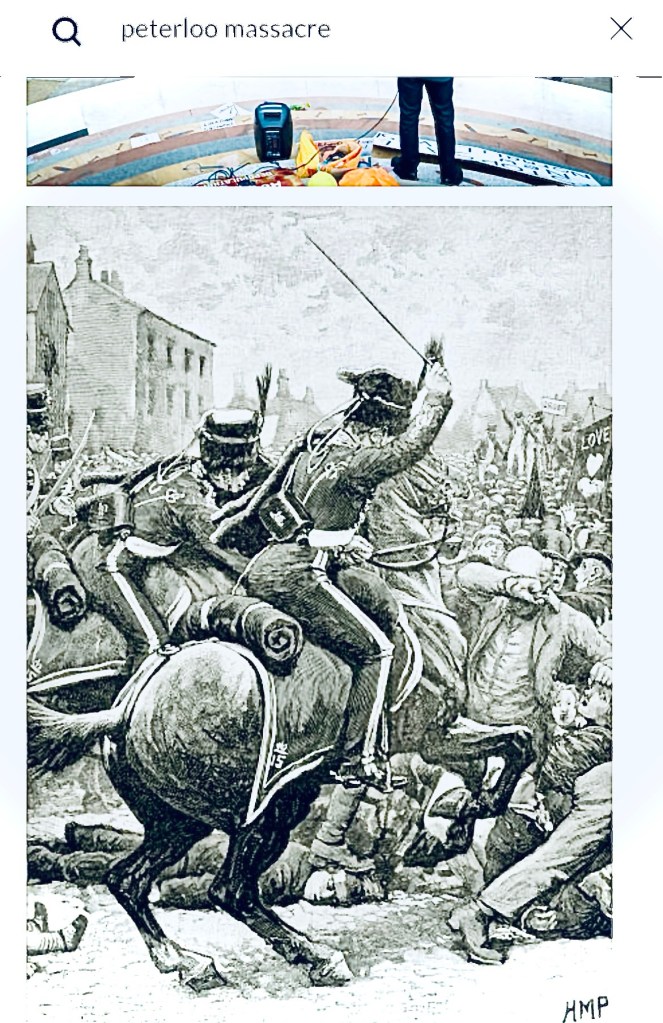
St. Peter’s Fields: The Peterloo Massacre 1819

..the title of this document comes from the work of The Joyce Project, Chapter [3], Proteus. I really wanted ‘Crackajolking away like a hearse on fire,’ which until this constituted a thumping 3.7 per cent of all I ever read of Ulysses. Ahm, the A Portrait of the Artist as a Young Man – Stephen Dedalus – was a story I did read read right through as a youngster but. Year 9 I think.

This book is partly a homage to those who in the past hundred years have paved the way for extraordinary change against all odds. It is a tribute, too, to survivors and activists who work, often at risk to their own lives, to ensure justice can be achieved today and in the years to come.

I am privileged to have met and worked with some of those I have written about. I met many more inspiring people while writing this book. But the challenges they face are huge. [During the past few years, the dangers of a pick-and-choose approach to justice, which some governments STILL SEEM DETERMINED TO MAINTAIN, HAVE BECOME MORE GLARING THAN EVER.]

Prosecutions of the powerful are not a cure-all. They do not end the pain of the crimes committed. They do not wave a magic wand and create world peace. Justice can, however, provide at least the beginnings of a framework for stability. Conversely, lack of justice, and the festering resentments that result from that sense of injustice, provide fertile soil for insecurity and the renewed cycles of violence.

With the right leadership, [national/ country-based] and international courts can help achieve an acknowledgement of truth which otherwise may remain missing. With the wrong leadership, denial and instability continue to thrive. Zoran Djindjić, the Serbian prime minister who delivered Slobodan Milošević to The Hague in 2001, understood the importance of a country confronting its own history. After Milošević’s indictment but while he was still in power, Djindjić told me of his fears of a “flight into a historic world” [and the dangers of the belief that Serbs ‘have been victims for six hundred years, and we can do what we want’ ]. Djindjić was assassinated in 2003 by those who did not want such uncomfortable truths to be spoken; a few weeks earlier, he had told Hague prosecutor Carla Del Ponte that he knew he would be killed. Serbian and Bosnian Serb leaders in the years since have often been less willing to confront history and responsibility.

Chapter 10 Balancing the Scales excerpt //

To conclude today, it now becomes axiomatic that every man and woman drawing a fat or a thin salary in public life in his or her country immediately familiarise themselves with the new and indeed old-era epoch-making terms of Steve Crawshaw’s Prosecuting the Powerful : War Crimes and the Battle for Justice, The Bridge Street Press (Little Brown http://www.littlebrown.co.uk London Hachette http://www.hachette.co.uk Dublin) 2025 or get the bloody hell out of public life.

John Blundell

Australia

University and Internet Reform Worldwide

Neurocognitive Heath in Child Youth Adult Aged Persons’ Learning

The Authentic 2 – 5 set Series Post Socratic Quantum Relations in Human Interpersonal Transactions LOGIC

Post 1944 & Post-neokeynesian Economics

Life, Love, & Everything with a bit less Living, Loving, & Party-going even with those absurd if not preposterous athematical neoclassical (?) commas preceding the logic & maths conjunctor And

Laughs

Shitloads of those

Rise & Rise of Electoral Autocracy Particularly in Dumb-di Dee Countries in the Third Decade of the 21st Century

In the memory of Paul Short, also from a sharefarmer family, and once-upon-a-time on the Cranbrook bus each morning too, of his mum & dad Kath & Keith, and of our superhero footballer Vincent Copley

1. Law, Constitution and Militarised State

“This was the man who fought Hellenistic influence in Rome, and nayurally lost – though a name which becomes a rallying cry for centuries has not altogether lost. It is easy to caricature Cato, for he lends himself to it; and there are many traits in his character which repel us. His treatment of his slaves was inhuman; he gloried in his asceticism; he seemed to deny pleasure to others and therein to gain his own twisted pleasure. He may be called narrow, uncompromising, insensitive, vain, sanctimonious, ostentatiously priggish, if it were not for his humour, self-righteous, if he were not fighting for an ideal. He may have cast himself for a part, and overacted, but his sincerity remains. It is also easy to misinterpret his oposition to the fashionable cult of things Greek; there is something to be said on his side.

“He knew Greek all his public life, for Greek was necessary to any statesman who had dealings with the East. He knew well the works of Greek orators and historians; he took a Greek translation of a Carthaginian work as his model in his book in agriculture. He tells his son to look at Greek literature, but not to lay it to heart, for they are ‘a scoundrel and incorrigible race’.

“It is not intellect which Cato despises, [but the contemporary use of intellect to undermine character. His ideal is the citizen of high moral principle, based on tradition, realising himself in the commonwealth and in business, and so creating a triumphant government pre-eminent for enlightened policy and massive integrity].. his own definition of an orator was vir homus dicendi peritus, a man of high character who can make a good speech.

“The sophists of Socrates’ day had boasted their skill to make the worse appear the better cause, and the Greeks of the third and second centuries2 were their heirs1.

“The self-assertion of individual personality3, such as Scipio loved, was the reverse of Cato’s ideal – action, in the midst of a community, inspired by a moral motive: personal influenc and charm were dangerous, thought Cato, and went to the other extreme.

“The modern self-culture led to sel [fi-ndulgence] in the name of art and fashion. The springs of action as discovered by ‘the noblest Romans’ were dried up at their source; for Cato [as now not perversely for ALL ontology, child development AND MENTAL HEALTH scholars] all true knowledge issued in action, and action revealed the man. Introspective absorption in self and its culture [as MASSIVE tranches and swathes, now VASTLY junk-data-profligate largely European-origin ‘Greta Thunberg’ bourgeois blather and blah having had their ‘pin-point’ aetiological ‘beginning’ or origin in Eighteen-hundred year-old later ‘mid Atlantic’ ‘Introvert-extrovert’ popular psychology attest] meant the collapse of a common morality; and then would emerge the ‘leader’, casting his spell by the cleverness of word and promise over a characterless people. ..

“The Roman constitution was an oligarchy & it was based on law & custom: the sons of the oligarchy were mltplyng their luxuries: the cult of the indvdl’s tastes and caprices in ndffrnc to all else was being interpreted as freedom: the laws & the unwritten codes were bcmng of less use.

“When Scipio was publicly charged with malversation of public funds in his campaigns, he invited the people to go with him there and then to the temples to render thanks for his victories; for it was the anniversary of the battle of Zama. He was triumphant – on personal influence and popular sentimentalism. No wonder Cato was afraid.

“Scipio was eventually found guilty, but none dared arrest him, and he died in semi-exile. Cato survived him; but, as he himself said, it is not easy to have to render an account of your life to an age other than the age in which you have lived.

“Cato could not win; the Roman city-state was passing away. The wealth of the world, and Asiatic notions of the use of wealth, were entering Rome.

“The ideal of Scipio Africanus and the ideal of Cato stood in open contrast. When Cato was an old man and Scipio already dead, an attempt at the reconciliation of the two ideals was made by Scipio Aemilianus, son of Aemilius Paulus and adopted into the family of his uncle, Scipio Africanus..”

2, The Therapeutic Sensibility

Godness only nose what the preceding five paragraphs bar one were about – let us simply c’est they represented some archaic shit albeit about legendary iconic Roman systematic colonising brutal quadrispheric hegemonists of Two-thouand years ago on the other side of the world well from where we Australians are at, so try this neckst bit OK ?

PERHAPS the letter which Pliny wrote to a friend about the death of the daughter of Fundanus will give a hint..

“I am very sad to write to you, for our friend Fundanus’ youngest daughter has died. [I never saw anything more jolly than this girl, more loveable or more deserving not only of long life but almost of immortality]..

“She was not yet thirteen years old, and she had all the sense of an old woman, the dignity of a mother, the shy innocence of maidenhood with the sweetness of a young girl. How she used to cling to her father’s embrace, and throw her arms round the necks of his friends in her affectionate and shy way. She loved her nurses, teachers and tutors, each in return for what they had done for her. Her reading, how eager and intelligent it was, her play how restrained and circumspect! And think of the self control, the patience, the courage with which she bore her last illness. She did all that her doctors told her to do; she tried to cheer up her sister and father, and by strength of will she kept her weak body going as its strength slipped away. Her will lasted to the very end, unbroken by her illness or by fear of [the death which was to give us all the more urgent cause to miss her and mourn her]. Her death was indeed a bitter sorrow; it’s blow was made even worse by the monent of its coming.. [Fundanus] is a learned and reflective man, the sort of man who has given all his life to serious study and pursuits; now he rejects with loathing all the counsel he has so often heard and given, and, [driving out of his mind every other ideal, he is utterly given up to thoughts of family affection]. You will understand him, indeed you will admire him if you reflect what he has lost. [He has lost a daughter who no less mirrored his character than his features and expression; with a remarkable resemblance she bodied forth her father’s very self..] An interval of time will do much to make him more ready to accept your comfort. A wound which is still raw shrinks from the doctor’s touch, then it endures it and then actually wants it: in the same way grief when fresh rejects and shuns attempts at consolation; soon it desires them and finally acquiesces in them if they are gently made.”

3. Anne McBurney, 11yrs, Died 1961

It turns out inveterate romantic scribbler and Homo-erectile cockwomble Pliny’s wife – not he’s missus, him – er, Possession is nine points of the law when it comes to you chicks – was Calpurnia – her of the world-famous pale cheek (students can search this – aw what-the,. i will be back in a tick.. mother-of-Jaisus4) wrote “believe me there is nothing I should like better than to have you with me.. to get you well again, believe that there is nothing I want more than that you should be well.. If you do what is best for your health you are obeying implicitly my wishes.. Your first business is to get well; of your countless kindnesses to me, this will give me the most pleasure. (Nov. 3rd, 50 B.C.)”

Anne lived in a likely1860 English or Scottish, Cornish or Welsh stone cottage in the limestone country of eastern central Yorke Peninsula – not ‘Yorke’s’ for Christ’s Sake you 20th century neoclassical Socratic Youth-culture Advertising-industry people, please – so you wanna read world-changing cultural neurolinguistics essays then expect a bit of psychic bruising OK? – in a grainlands neighborhood called Cranbrook nobody except old people has heard of nowadays and was picked up for school Monday to Friday in a Kombi driven by Mr Trembath who also lved in a 90-odd years old stone cottage (that got burned out a couple of years later) in the town.

She sat on the north side of of 5-6-7 classroom of the government primary school in the town.

Anne got mingka when she was in Grade 5 and like my dad’s mother Hannah Brennan at Macclesfield 45 years earlier died of TB (tuberculosis, a respiratory system disease5).

Hers was the first death i cared about. I had no opportunity to mourn her except to myself. That was my community’s attitude towards death. Two years before I had fallen unconscious on a balcony off the back verandah after being ‘left to my own devices’ all night essentially on account of gross parental neglect. You learn fast. Fast enough if you’re lucky, Chucky.

John Blundell

Your ‘veteran’ Miracle-goals guy from 1988

Thinking Stuff-through, L,L & E, Quantum-physics, Thematics, Futures

1 Nhh-hn

2 Serious head-kicking Economics professors (transitive verb formatting there) homonymic powerfully ANTI CLASSICAL/ animist/ monist word-game, YOUNG PEOPLE: Purse-anality. …next you might examine the psycho-cultural roots & origins of cognate or similar-SOUNDING terms Parsimony, Pusillanimity and many alia. On Sounds [speech is all and your formal or official Display & Announcement 9performative voice STRICTLY ONLY half of your social self] – (i) take up watching Sesame Street again (ii) channel the antithetical Dr Timothy Leary 4ROM your memory bank (= Tune out from the Other’s read-only memeory nonsense,sloganising or recitations, Switch off all the 2 bit actors, and Drop in to your lived experience households, neighborhoods and local communities

3 the writer knows it’s not best practice to guffaw and slap his sides in a super-heavyweight academic paper that’s set to break a shitload of proverbial hearts and likely impel hundreds of thousands into retirement or immediate withdrawal from public life but check out the objectifying-of-time-intervals implicit in “oh of course, third, second” – Ideas are things monism yet again feeding straight in to the psychoverse of vast culturally and economically energy and water profligate idiot intelligence with no concept either of global environs under a broken sky or futures except absurd projections on junk past historical/ “hysteric” recorded observations

4 In the scene, Calpurnia’s pale cheek is mentioned alongside a description of Cicero’s eyes. The line appears as part of a longer passage that includes: 

  • “But, look you Cassius, The angry spot doth glow on Caesar’s brow” 
  • “And all the rest look like a chidden train” 
  • “Calpurnia’s cheek is pale, and Cicero, Looks with such ferret and such fiery eyes” 

5 A total of 1.25m people died from tuberculosis in 2023 incl. 161,000 with Human Immunodeficiency Viruses – two species of Lentivirus that infect humans
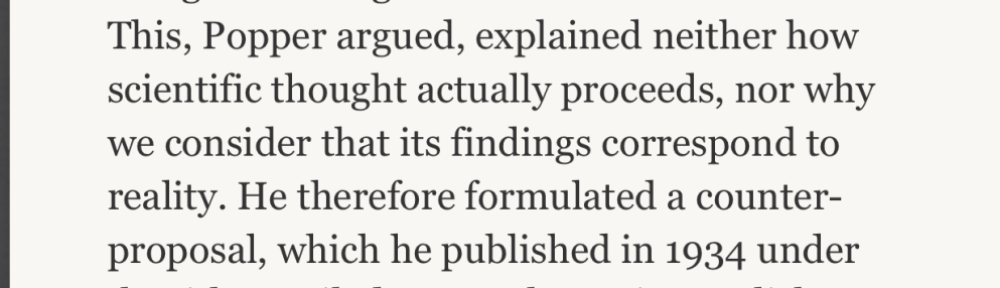
Microsoft Co-pilot & AI Anti-Historical Referencing + Utterly Frightful Dumbdown Sam Altman Issues ,. Maybe Try Again ., >>

Students you should make deliberate (not casual ‘quiz-show’ expert/ competitive egotist child actor oeuvre) note that classical textual punctation is utilised in the formatting of the following transcript from RH Barrow 1949 by myself strictly for linguistics education\ Other-branded & diagnosed disturbing element cum bad actor

🦘
🇦🇺

‘s whoowhoo 1960s\ and I hope to arouse if not ideationally-activate your new era 2-5set series maths-logic “learnings” (it’s a ‘trip.’ ..enjoi).

“Later, these same hill-men moved down to the plains and settled upon the site of the ‘Seven Hills’ of Rome. They were a pastoral folk. Their earliest festivals were concerned with the interests of shepherds ; milk, not wine, is the earliest offering, and wealth was reckoned in cattle ; the very word for ‘money’, pecunia (whence ‘pecuniary’), means ‘head of cattle’. They found other men of kindred race, Sabellian and Sabine, moving upon the plain and settling upon the higher ground; from the fusion of these settlements Rome took her origin. From her central position her soldiers could move north and east and south – along the valleys north and east, and down the plain to the south ; they soon learned the value of ‘interior lines’ .”

[Students, your lovely drawing of a kangaroo and the flag of Great Britain that we all so cherish we’d like to wrap around ourselves and quite possibly do naughty ‘things’ ‘in’ were inserted by virtue of operator error but i thought hey that’s good – and it’s only taken me another 9 1/2 minutes to jemmy it up and do a brief but not at all perfunctory or peremptory Welcome-to-my-country not wanting to get in trouble with the Professors of English Literature in 42 universities, ncldng 37 public, 3 private & 2 private international uh-oh make that 16mins 14, 15, 16 .. Will you stop being so naughty Kevin?! .. 47. 56.. But it’s highly pedagogic, Mother. The students are getting well and truly to grips with the differentiated but intimately intertwined 6, 8 or perhaps even10 psycho-culturally generated constructs of time. You’re as mad as a meat-axe, Kevin ;\: you’re worse than your father.]

“Indeed, some have thought that the site of Rome was chosen from the first as an outpost against the Etruscans from the north. And here, for the moment, we leave the Romans, as they join with outlying settlements, and turn to agricultural pursuits and trade with Etruscan and Greek merchants.

“To the north of the Tiber lay the Etruscan empire. The Etruscans were probably sea-wanderers (from the East?) settled at last in etruria, or Tuscany – cruel, overbearing, worshipping gloomy gods of the underworld and divining the future from the organs of slaughtered animals. They built enormously solid walls to defend their cities, and they traded with greek cities and with Carthage in Africa, and thus ‘borrowed’ fro civilisations superior to their own. From the sea they penetrated into the Campanian plain, and in the seventh century tried to move south to occupy it, circling round the hills to the east to avoid the swamps, and seizing some of the Latin towns on the high ground.

“About the time of the Latin migration to the ‘Seven Hills’, Greeks began their long process of seizing the best harbours on the south and west coasts of Italy and the eastern side of Sicily ; the Carthaginians, too, occupied the western half of the island. At first the Greeks wanted only trading stations, but in time colonies were sent from Greece to establish cities which soon became among the fairest of the Mediterranean. Perhaps the earliest Greek settlement was Cumae, on the bay of Naples, in the eighth, and of great moment to Europe ; for from the Greeks of Cumae the Latins learned the alphabet ; the Etruscans too adapted the same letters to their purpose, and passed them on to the inland tribes. From Cumae, also, Italy may first have learned of Greek gods, such as Heracles and Apollo. But the chief settlements of the Greeks werer in the extreme south of Italy and in Sicily. Syracuse and Agrigentum in Sicily, and Tarentum, Sybaris, Croton, and Rhegium in South Italy are all Greek in origin. They are most important in Roman history, for through them Rome came into full contact with the Mediterranean world.

” The Etruscans and the Greeks were the two most powerful influences during Rome’s early years. The rest of Italy was sparsely inhabited by tribes, many akin to the Latins. They lived in comparitive isolation in their hills, tending flocks and tilling the land and grouping together into settlements, as geography allowed, for defence and trade and worship.

“Now let us return to the Romans. The first three kings were Latins, the last three were Etruscan. The last of these was ejected by violence (traditionally 510 B.C.), and the word ‘king’ became anathema to the Romans. Yet the Etruscan influence remained. Temples and rites survived ; Jupiter was still enthroned on the Capitolene Hill, Diana on the Aventine. The insignia of Etruscan rulers became those of Roman magistrates, the ‘ivory chair’, the bundles of rods with two axes bound up with them (fasces). But, more important, Rome acquired an organisation which was to turn her into an imperial power.

“Till about 270 B.C. Rome fought perpetually for existence in Italy, and her fight could not cease till she was recognised as a leading power. The highest qualities of courage and resourcefulness were called for ; one tribe after another was overcome, and was incorporated on varying terms into the Roman state or sphere of influence. Leagues and alliances were created. At one crisis, the sacking of Rome by roving Gauls in 390 B.C. – the Latin cities failed to aid her ; they suggested federation, and Rome made up her mind that safety lay only in their conquest. At great self-sacrifice she reduced them to obedience, and then went forward as tribe after tribe appealed to her for aid, and eventually for alliance and the extension of her ‘rights’ to their cities. At last, Thurii, in the ‘instep’ appealed for aid against Tarentum. Rome hesitated – and agreed. Tarentum brought in Phyrrus, King of Epirus across the Adriatic ; and Rome emerged from his invasion of Italy the leader of the Greek states in South Italy. Thus, she passed into the sphere of the Carthaginians whose trade covered the seas of Sicily aand thge Western Mediterranean After half a century of struggle (264 – 202 B.C.) it was decided that Rome should become a ‘world power’, and that the lands of the West should be ruled by an Aryan, not a Semitic race.”

Oh hoodly-doodly young people we have really or at least virtually

KEVIN, will you stop playing the class clown ?!

Mum it’s just a bit of a gag – i’ve been trying to teach our manly but largely vile priapist sheeple mweeple freeple, the St John the galaxy-scale bonghead of the Isle of Patmos – or Nova Scotia or was it Newfoundland – there be dragons and were icebergs floating by – the Bernaysians & the Lost-it Friedmanites about the Dialectics of the Damned which do they believe it or not don’t actually trade off or read out neatly or at all for goodness’ sake either with Quantum-relation qubits or Noah’s Freaking Arc – of the Covenant, you what – carpenter’s cubits since I wrote that one and only neat succinct short essay of the name for Green Economist newsletter in i believe1994.

Perhaps a note on the ontology of belief – to touch lightly on the questions of time at the beginning of this essay for I don’t want readers trampling any primary schooler’s or teenagers dream I do believe 1994 (and a heap of other years back to 1912 when my late father was born), no?

And a note – it’s a government-breaker this one. “Getting Franklin’s story right is crucial, because she has become a role model for women going into science. She was up against not just the routine sexism of the day, but also more subtle forms embedded in science — some of which are still present today…” so coy it’s Yogi Bear, Barny Rubble & Buffy Vampire-slayer cute, huh? Erp. Thank you for your readership. – You didn’t sign any paper? Oh yeh…

https://www.nature.com/articles/d41586-023-01313-5

John Blundell

Australia

An excerpt from RH Barrow The Romans 1949 Negotium – the state

(b) CICERO

The race of man shall perish from the earth before the glory of Cicero shall perish from their memories. VELLEIUS PATERCULUS

Cicero stands near the end of the age of conflict and disruption. From his pages we can reconmstruct much of the story of his time, as seen from the viewpoint of a member of the aristocracy. He was born in 106 BC and was put to death by Antony a year after the murder of Julius Caesar in 44 BC. His extant works take up eighteen volumes in a small pocker edition published in 1823; three volumes of ‘rhetorical’ treatises (or literary criticism and ‘education’), six volumes of speeches written to be delivered in Senate or law-court, four of philosophical works and one of fragments. In all these pages there is little that tells us of the manner of life led by the majority; in Latin literature, as in Greek, the outlook is that of the few. In Rome the government was in the hands of an oligarchy drawn from families ennobled by service to the state and counting among its numbers the most highly cultivated men of the day, In the writings of Cicero, the strength and the weaknesses, the blind prejudices, the massive culture, and the corruption of private and pulic integrity stand out clearly. He was a ‘new man,’ that is, he did not belong to one of the old families; he came from Arpinum, and like many before him he had migrated to Rome to stand for office as the preliminary to a public career. He was eminently successful, and after his famous consulship in 63 BC had held a short and inconspicuous term of office as proconsul in Cilicia. In senatorial circles – for, of course, he was a senator – he moved freely, for he was a leading advocate, politician and man of letters. Occasionally a slight trace of social uneasiness can be detected. He loved Rome and was miserable when away from it. To him and to his circle the only work that counted as work was in the service of the state (negotium); all else, no matter how urgent or exacting, was ‘time off,’ even though it might include a man’s main livelihood. For this class, land was the only worthy occupation; trade and industry were not acceptable pursuits. It was not that these men were above money; money was their curse, and some of the largest fortunes of history were gathered into the hands of men like Lucullus and Crassus, and were often expended on luxuries wicked and futile; moreover, towards the end of the Republic, senators evaded the rules forbidding them to have interests in trade and industry and transacted business of all kinds through intermediaries. What they disliked was retail trade and the routine of manufacture. But they were on close terms with contractors and producers ‘in a big way’ and with financiers and bankers; and they readily sold their estates and country houses and bought others, and speculated in the land and ‘house-property’ markets.

These men of senatorial rank moved about Rome and Italy and the provinces as though they were a race apart.. [Section report //]

NOW LADIES i WANT YOU’ALL TO BE ON your BEST BEHAVIOUR ALRIGHT ALRIGHT ALRIGHT AS WE ‘GO’ TO ( b ) THE FIRST AND SECOND CENTURIES A. D.

O Jupiter of the Capital, O Mars Gradivus, author and stablisher of the Roman name, O Vesta, guardian of the sacred flame that burns forever, and all the gods who have lifted this massive Roman Empire to the grandest pinnacle of the whole world upon you in the name of the people I call in supplication : guard, preserve, protect this order, this power, this Emporer : [and when he has discharged his spell of duty upon earth, as prolonged as it can be, then raise up at the last hour men to succeed him, men whose shoulders shall be no less broad to bear the burden of world empire than we have seen this Emporer’s to be : and of the counsels of all citizens prosper what is pleasing to you, [and bring to nought what is unpleasing.] VELLEIUS PATERCULTUS

the unmeasured majesty of the Roman [peace]. PLINY THE ELDER

[Rome is our common fatherland.] MODESTINUS (Digest)

To be continued

Liminal Time

Álvaro García Linera

Apr, 2024


Álvaro García Linera is a Bolivian politician and intellectual, Vice President of Bolivia during the tenure of Evo Morales. A Marxist theorist, prolific essayist and columnist, he was a member of the Ayllus Rojos guerrilla and the Tupak Katari Guerrilla Army during the 1990s. He was incarcerated for five years as a political prisoner, and since his release he has been a member of the MAS-IPSP, serving in the popular government that transformed Bolivia.

Liminal time signifies an abrupt disruption in the continuity of social experience, leaving societies without a conceivable alternative or any plausible foresight. (…) It marks the end of one era and the onset of another, not through a gradual shift or a gentle, “amphibious” blend but as a profound emptiness. 
A liminal event represents both a subjective and collective experience of social time during the transitional phases of accumulation-domination cycles. It marks the end of one era and the onset of another, not through a gradual shift or a gentle, “amphibious” blend but as a profound emptiness—a desperate, intimate absence. Liminal time signifies an abrupt disruption in the continuity of social experience, leaving societies without a conceivable alternative or any plausible foresight for several years, perhaps even decades. It is during such times, amid social upheavals, that a new historical epoch gradually begins to emerge, offering a renewed sense of hope to communities. However, until this new dawn materialises, the liminal epoch exists as a profound interim—a void filled with anguish, a palpable emptiness, a suspension of time itself.
The Paralysis of the Predictive Horizon. Societies traditionally orient their notion of the future—whether real or imagined—around a predictive horizon. As the neoliberal predictive horizon dissipates, the concept of a future itself vanishes; there is no destination to anchor mobilising hopes sustainably. Emerging expectations, if not globally consolidated, prove ephemeral, quickly foundering back into uncertainty and disaffection.With no envisioned tomorrow that improves upon the present, there also ceases to be a path—whether straight, winding, fragmented or uninterrupted—by which to navigate the present dilemmas about imagined well-being. Social time evaporates. It is inherently a flow—turbulent and discontinuous but aimed towards a horizon, a goal, a destination. Faced with a future rendered empty, society finds itself mired in the tangible experience of a suspended historical time, devoid of progression towards any ends, adrift in a meaningless present extended to infinity, as if time itself had lost its way … The suspension of time does not eliminate the experience of “lack of time,” which is characteristic of modernity and involves not having enough physical time to fulfil routines, duties and daily inertial commitments. Frozen time pertains to the envisioned progression of collective history; it is the time measured in relation to a desired future, and now, that time is interrupted. This situation is distinct from the religious concept of “end times”, which, despite being catastrophic, represents a defined destiny. … 
With the future extinguished and the present unhinged, the very trajectory of social life seems to have been derailed. … According to thinkers like Hartmut Rosa [33] or Mark Fisher [34], the acceleration of events is no longer an actual acceleration of time, as the arrow of historical time has gone astray. Events accumulate without a metric to “measure” them, with nothing to compare them against. They occur without a hopeful future, merely as avalanches of events with no societal direction or destination. Physical time is compressed within a whirlwind of events and demands, yet historical time remains stagnant, lacking a horizon to provide it with vitality and movement. Ultimately, the existence and recognition of historical time are both symptomatic and indicative of the major political hegemonies and their declines.We are not merely confronting a fragmented and discontinuous time, as Byung-Chul Han suggests. [35] Since its emergence 40 years ago, the structure of neoliberal time has been characterised by both atomisation and acceleration. This condition is mirrored in the new labour environment, which has fragmented workplaces into myriad small, outsourced factories. Similarly, the life trajectories of wage earners have become fragmented, with individuals submerged in perpetual labour nomadism. … However, over these four decades, this fragmented experience of social elements unfolded within an imagined historical trajectory, centred around the gratification of individual effort, the global market, competitiveness and economic accumulation. Despite the chaos and discontinuity in personal events, there was a shared belief in a satisfying destination—an epochal certainty that provided a sense of purpose and coherence, helping to piece together the polychrome fragments of life. However, today, that sense of destination, which once gave meaning to life’s trajectories, has vanished.


Immediately republished, on account of international urgency on macroeconomic management, in connection with this week’s commentary on both economy and philosophy of science (including the maths and ‘thematics’ of quantum physics, how its popularised terminology has skewed debate on Time discussed usefully and evocatively here at this moment of global polycrisis by Alvaro Garcia Linera), and in my view the gravely misdirected enthusiasm for the quantum computing proposition on my @X account, from Chartbook with enormous thanks to @Adam_Tooze

John
17/5/2024