Part-time independent journalist, Australian regenerative & organic farming pioneer 1988 until a total family & Labor Party/ CPSU fraud, lived in virtual exile 13 1/2 years, now part time commercial organic b/ d veg gardener central Adelaide Hills
So I’m 6 days into Covid, my brain feels like cottage cheese, but I still want to try to say something about this permitting bill & the way that climate politics seems to be shaking out after the fade-away of the #GreenNewDeal.
It’s supply-side climate policy and it’s bad.
1/n
The vision of the #GreenNewDeal was to connect climate policy to a large host of policies that would raise the majority’s real income—quite aside from what people would save on clean compared to fossil energy—and thereby win a entrenched constituency for decarbonization.
2/n
The idea, as I understood it, was that this broad constituency would arise in addition to whatever vested interests in decarbonization would be developed by establishing clean-energy industries, a climate corps, etc.
3/n
The proponents of the IRA{2} also imagine that new political coalitions will be built by the establishment of domestic clean-energy industries—and they may well be. But the majority of Americans still lose money, even with the IRA’s generous credits and rebates, because…
4/n
…to participate in climate action, Americans are being asked to act as individual consumers: to spend money on buying a new EV and retrofitting their own homes.
This approach still dumps the costs right in people’s laps, before they start to feel the benefits.
5/n
And yes, things will be much cheaper—but you’re still being asked to spend money.
This approach to decarbonizing electricity and transportation is the antithesis to a public works project whose costs are socialized and that offers the public benefits directly.
6/n
But the faith in markets as rational and reasonable, and consumers as perfect little cogs in the wheels of the market, seems to be unshakable. Make clean energy cheap, and people will pay to switch.
7/n
How much more neoliberalism must we have before we accept that markets don’t solve social problems?
8/n
And I would entertain the argument that the US is taking this market-based approach to climate policy only because it’s the only way to pass policy through the Senate, if…
9/n
…if it were not for the unholy alliance of fossil fuel interests, powerful energy modelers, centrist pundits, and climate journalists who are pushing to weaken NEPA{3}, shaming environmentalists in the process.
Supply-side climate policy IS the strategy. It’s not a “compromise.”
And here’s the thing: it’s not going to work to solve the climate and ecological crisis that we’re currently in.
Yes, we need to build a fuck-ton of renewable energy, transmission, infrastructure, etc.
But that’s not ALL we need to do.
11/n
Because, I’m sorry, but the crisis we’re in is not just about switching out one form of energy for another while leaving the rest of the system in place.
12/n
I don’t actually think that degrowth is a viable political program, but degrowth research has nonetheless made the incontrovertible point that everything we extract and bring into our economy and everything we emit as waste “out of” our economy is part of the climate problem.
13
In addition to phasing out fossil fuel energy, we also need to integrate our economy into planetary boundaries.
14/n
Yes, I know, I sound very crunchy. I’m sorry. I’m from New York. I grew up liking ballet, and Paris, and Madonna and Prince. I thought nature was gross. I had no interest in ecology until I was well down the climate rabbit hole. But there it is. Planetary boundaries matter.
15/n
Anyway, my point is that the Democrats and some of the most well-positioned and influential voices in academia and media are starting to coalesce around pushing for and celebrating supply-side climate policy (increase supply of clean energy and voilà: problem solved).
16/n
Not only does this religion of markets (sustained by the ritual of math with made-up assumptions which is economic modeling) totally ignore how the power of intrenched fossil interests actually works, and how people power must be built to overthrow it, it also…
17/n
…it also makes decarbonization a series of consumer choices, which is bound to lead to, at best, a partial solution.
18/n
For even if everyone bought an EV, solar panels, and an induction stove, we would still need not just a decarbonized, electrified economy, but an integrated economy in order to stop destroying the planetary systems that, let’s be frank, enable us to live.
/fin
1. this is of course my “sub-editor’s” title for @DoctorVive’s beyond apposite but trenchant and swingeing albeit off-the-cuff ECONOMIC appraisal after herself suffering a #COVID_19 episode. Most of our good and good-hearted readers already know that governments in late 2022 trying to maintain an electoral NEO-liberal majoritarian charade based upon the supposed macroeconomic/ monetarist bulwark or overflowing Fort Knoxs (or #Crypto money in the “sky” or Aladdin’s Caves full or laundered cash) of unregulated & newly disregulated free-market entrepreneurialism where there is bizarrely no place at all for government “interference” can only alienate BILLIONS more human beings from their insanely technically-ignorant & hubristic (arrogant) deluded deracinated, (uprooted from one’s natural geographical, social, or cultural environment)* entirely vicarious tv drama & kiddie cartoons Boy’s Own adventure, mystery, magic, variously staunch dogged or teeth-gritting & heroic exploration, moonshots mentality AND are literally signing their own death-warrants.
..to which we respond by saying keep on, articulate these messages. Their content & import to us is unknown to the oppressed, violated & about to be written down as human assets.
*Deracinate was borrowed into English in the late 16th century from Middle French and can be traced back to the Latin word radix, meaning “root.” Although deracinate began life referring to literal plant roots, it quickly took on a second, metaphorical, meaning suggesting removal of anyone or anything from native roots or culture – Merriam
3. National Environmental Policy Act, EPA plays a unique role in the National Environmental Policy Act (NEPA) process. EPA has responsibility to prepare its own … https://www.epa.gov/nepa
**This entire article per courtesy e360.yale.edu **
Renewable energy skeptics argue that because of their variability, wind and solar cannot be the foundation of a dependable electricity grid. But the expansion of renewables and new methods of energy management and storage can lead to a grid that is reliable and clean.
As wind and solar power have become dramatically cheaper, and their share of electricity generation grows, skeptics of these technologies are propagating several myths about renewable energy and the electrical grid. The myths boil down to this: Relying on renewable sources of energy will make the electricity supply undependable.
Last summer, some commentators argued that blackouts in California were due to the “intermittency” of renewable energy sources, when in fact the chief causes were a combination of an extreme heat wave probably induced by climate change, faulty planning, and the lack of flexible generation sources and sufficient electricity storage. During a brutal Texas cold snap last winter, Gov. Greg Abbott wrongly blamed wind and solar power for the state’s massive grid failure, which was vastly larger than California’s. In fact, renewables outperformed the grid operator’s forecast during 90 percent of the blackout, and in the rest, fell short by at most one-fifteenth as much as gas plants. Instead, other causes — such as inadequately weatherized power plants and natural gas shutting down because of frozen equipment — led to most of the state’s electricity shortages.
In Europe, the usual target is Germany, in part because of its Energiewende (energy transformation) policies shifting from fossil fuels and nuclear energy to efficient use and renewables. The newly elected German government plans to accelerate the former and complete the latter, but some critics have warned that Germany is running “up against the limits of renewables.”
NEVER MISS AN ARTICLE
Subscribe to the E360 Newsletter for weekly updates delivered to your inbox. Sign Up.
In reality, it is entirely possible to sustain a reliable electricity system based on renewable energy sources plus a combination of other means, including improved methods of energy management and storage. A clearer understanding of how to dependably manage electricity supply is vital because climate threats require a rapid shift to renewable sources like solar and wind power. This transition has been sped by plummeting costs —Bloomberg New Energy Finance estimates that solar and wind are the cheapest source for 91 percent of the world’s electricity — but is being held back by misinformation and myths.
Myth No. 1: A grid that increasingly relies on renewable energy is an unreliable grid.
Going by the cliché, “In God we trust; all others bring data,” it’s worth looking at the statistics on grid reliability in countries with high levels of renewables. The indicator most often used to describe grid reliability is the average power outage duration experienced by each customer in a year, a metric known by the tongue-tying name of “System Average Interruption Duration Index” (SAIDI). Based on this metric, Germany — where renewables supply nearly half of the country’s electricity — boasts a grid that is one of the most reliable in Europe and the world. In 2020, SAIDI was just 0.25 hours in Germany. Only Liechtenstein (0.08 hours), and Finland and Switzerland (0.2 hours), did better in Europe, where 2020 electricity generation was 38 percent renewable (ahead of the world’s 29 percent). Countries like France (0.35 hours) and Sweden (0.61 hours) — both far more reliant on nuclear power — did worse, for various reasons.
The United States, where renewable energy and nuclear power each provide roughly 20 percent of electricity, had five times Germany’s outage rate — 1.28 hours in 2020. Since 2006, Germany’s renewable share of electricity generation has nearly quadrupled, while its power outage rate was nearly halved. Similarly, the Texas grid became more stable as its wind capacity sextupled from 2007 to 2020. Today, Texas generates more wind power — about a fifth of its total electricity — than any other state in the U.S.
Myth No. 2: Countries like Germany must continue to rely on fossil fuels to stabilize the grid and back up variable wind and solar power.
Again, the official data say otherwise. Between 2010 — the year before the Fukushima nuclear accident in Japan — and 2020, Germany’s generation from fossil fuels declined by 130.9 terawatt-hours and nuclear generation by 76.3 terawatt hours. These were more than offset by increased generation from renewables (149.5 terawatt hours) and energy savings that decreased consumption by 38 terawatt hours in 2019, before the pandemic cut economic activity, too. By 2020, Germany’s greenhouse gas emissions had declined by 42.3 percent below its 1990 levels, beating the target of 40 percent set in 2007. Emissions of carbon dioxide from just the power sector declined from 315 million tons in 2010 to 185 million tons in 2020.
So as the percentage of electricity generated by renewables in Germany steadily grew, its grid reliability improved, and its coal burning and greenhouse gas emissions substantially decreased.
In Japan, following the multiple reactor meltdowns at Fukushima, more than 40 nuclear reactors closed permanently or indefinitely without materially raising fossil-fueled generation or greenhouse gas emissions; electricity savings and renewable energy offset virtually the whole loss, despite policies that suppressed renewables.
Myth No. 3: Because solar and wind energy can be generated only when the sun is shining or the wind is blowing, they cannot be the basis of a grid that has to provide electricity 24/7, year-round.
While variable output is a challenge, it is neither new nor especially hard to manage. No kind of power plant runs 24/7, 365 days a year, and operating a grid always involves managing variability of demand at all times. Even with no solar and wind power (which tend to work dependably at different times and seasons, making shortfalls less likely), all electricity supply varies.
Seasonal variations in water availability and, increasingly, drought reduce electricity output from hydroelectric dams. Nuclear plants must be shut down for refueling or maintenance, and big fossil and nuclear plants are typically out of action roughly 7 percent to 12 percent of the time, some much more. A coal plant’s fuel supply might be interrupted by the derailment of a train or failure of a bridge. A nuclear plant or fleet might unexpectedly have to be shut down for safety reasons, as was Japan’s biggest plant from 2007 to 2009. Every French nuclear plant was, on average, shut down for 96.2 days in 2019 due to “planned” or “forced unavailability.” That rose to 115.5 days in 2020, when French nuclear plants generated less than 65 percent of the electricity they theoretically could have produced. Comparing expected with actual performance, one might even say that nuclear power was France’s most intermittent 2020 source of electricity.
Climate- and weather-related factors have caused multiple nuclear plant interruptions, which have become seven times more frequent in the past decade. Even normally steady nuclear output can fail abruptly and lastingly, as in Japan after the Fukushima disaster, or in the northeastern U.S. after the 2003 regional blackout, which triggered abrupt shutdowns that caused nine reactors to produce almost no power for several days and take nearly two weeks to return to full output.
The Bungala Solar Farm in South Australia, where the grid has run almost exclusively on renewables for days on end. LINCOLN FOWLER / ALAMY STOCK PHOTO
Thus all sources of power will be unavailable sometime or other. Managing a grid has to deal with that reality, just as much as with fluctuating demand. The influx of larger amounts of renewable energy does not change that reality, even if the ways they deal with variability and uncertainty are changing. Modern grid operators emphasize diversity and flexibility rather than nominally steady but less flexible “baseload” generation sources. Diversified renewable portfolios don’t fail as massively, lastingly, or unpredictably as big thermal power stations.
ALSO ON YALE E360
In boost for renewables, grid-scale battery storage is on the rise. Read more.
The purpose of an electric grid is not just to transmit and distribute electricity as demand fluctuates, but also to back up non-functional plants with working plants: that is, to manage the intermittency of traditional fossil and nuclear plants. In the same way, but more easily and often at lower cost, the grid can rapidly back up wind and solar photovoltaics’ predictable variations with other renewables, of other kinds or in other places or both.This has become easier with today’s far more accurate forecasting of weather and wind speeds, thus allowing better prediction of the output of variable renewables. Local or onsite renewables are even more resilient because they largely or wholly bypass the grid, where nearly all power failures begin. And modern power electronics have reliably run the billion-watt South Australian grid on just sun and wind for days on end, with no coal, no hydro, no nuclear, and at most the 4.4-percent natural-gas generation currently required by the grid regulator.
Most discussions of renewables focus on batteries and other electric storage technologies to mitigate variability. This is not surprising because batteries are rapidly becoming cheaper and widely deployed. At the same time, new storage technologies with diverse attributes continue to emerge; the U.S. Department of Energy Global Energy Storage Database lists 30 kinds already deployed or under construction. Meanwhile, many other and less expensive carbon-free ways exist to deal with variable renewables besides giant batteries.
Many less expensive and carbon-free ways exist to deal with variable renewables besides giant batteries.
The first and foremost is energy efficiency, which reduces demand, especially during periods of peak use. Buildings that are more efficient need less heating or cooling and change their temperature more slowly, so they can coast longer on their own thermal capacity and thus sustain comfort with less energy, especially during peak-load periods.
A second option is demand flexibility or demand response, wherein utilities compensate electricity customers that lower their use when asked — often automatically and imperceptibly — helping balance supply and demand. One recent study found that the U.S. has 200 gigawatts of cost-effective load flexibility potential that could be realized by 2030 if effective demand response is actively pursued. Indeed, the biggest lesson from recent shortages in California might be the greater appreciation of the need for demand response. Following the challenges of the past two summers, the California Public Utilities Commission has instituted the Emergency Load Reduction Program to build on earlier demand response efforts.
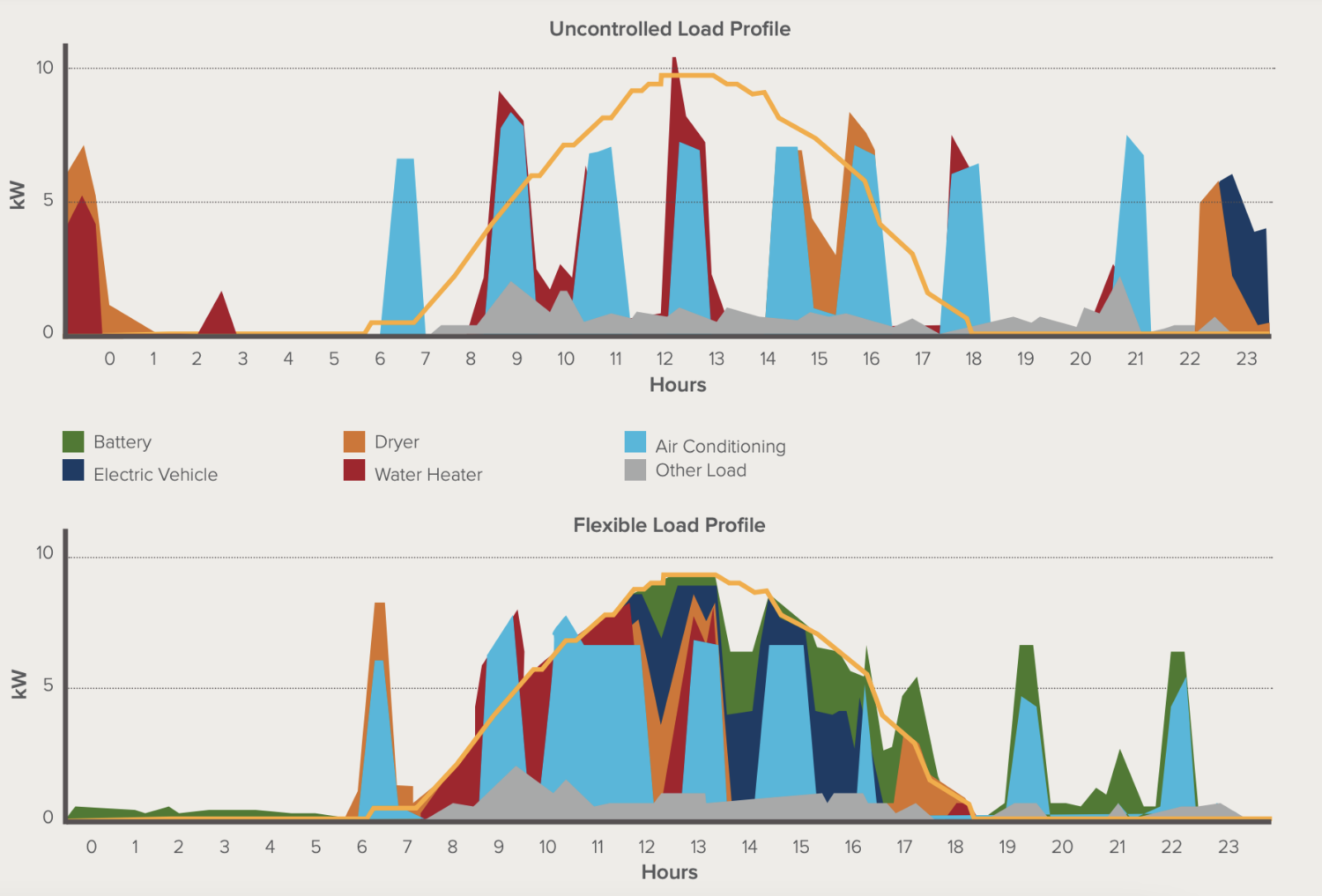
Some evidence suggests an even larger potential: An hourly simulation of the 2050 Texas grid found that eight types of demand response could eliminate the steep ramp of early-evening power demand as solar output wanes and household loads spike. For example, currently available ice-storage technology freezes water using lower-cost electricity and cooler air, usually at night, and then uses the ice to cool buildings during hot days. This reduces electricity demand from air conditioning, and saves money, partly because storage capacity for heating or cooling is far cheaper than storing electricity to deliver them. Likewise, without changing driving patterns, many electric vehicles can be intelligently charged when electricity is more abundant, affordable, and renewable.
The top graph shows daily solar power output (yellow line) and demand from various household uses. The bottom graph shows how to align demand with supply, running devices in the middle of the day when solar output is highest. ROCKY MOUNTAIN INSTITUTE
A third option for stabilizing the grid as renewable energy generation increases is diversity, both of geography and of technology — onshore wind, offshore wind, solar panels, solar thermal power, geothermal, hydropower, burning municipal or industrial or agricultural wastes. The idea is simple: If one of these sources, at one location, is not generating electricity at a given time, odds are that some others will be.
Finally, some forms of storage, such as electric vehicle batteries, are already economical today. Simulations show that ice-storage air conditioning in buildings, plus smart charging to and from the grid of electric cars, which are parked 96 percent of the time, could enable Texas in 2050 to use 100 percent renewable electricity without needing giant batteries.
To pick a much tougher case, the “dark doldrums” of European winters are often claimed to need many months of battery storage for an all-renewable electrical grid. Yet top German and Belgian grid operators find Europe would need only one to two weeks of renewably derived backup fuel, providing just 6 percent of winter output — not a huge challenge.
MORE ON YALE E360
From homes to cars, it’s now time to electrify everything. Read more.
The bottom line is simple. Electrical grids can deal with much larger fractions of renewable energy at zero or modest cost, and this has been known for quite a while. Some European countries with little or no hydropower already get about half to three-fourths of their electricity from renewables with grid reliability better than in the U.S. It is time to get past the myths.
Amory B. Lovins is an adjunct professor of civil and environmental engineering at Stanford University, and co-founder and chairman emeritus of Rocky Mountain Institute. M. V. Ramana is the Simons Chair in Disarmament, Global and Human Security and director of the Liu Institute for Global Issues at the School of Public Policy and Global Affairs at the University of British Columbia in Vancouver, Canada. MOREABOUT AMORY B. LOVINS AND M. V. RAMANA →
Rents & Property Prices Disastrously Inflated for the Investment Profit of Old Rich People and the Neoliberal Inflation & Growth Nerds of Both Major Party Groupings with No Idea of or Care for Responsible Economic Management
“The Commonwealth-State Housing Agreement of 1956 is commonly seen as marking a shift in policy and in political rhetoric, away from public housing provision towards private home-ownership. Before examining the evolution of this policy shift, this paper frames it within the context of the social history of the early 1950s, particularly the post-war affirmation of the independent family, with its commitments to domesticity as a basis of citizenship, but in a period when a severe housing shortage also signaled uncertainties about the reliability of the economic boon. The paper then examines in detail the evolution of the 1956 Agreement within the conservative parties, the Commonwealth bureaucracy and the Cabinet. It concludes that, even though home-ownership emerges from these debates as a central ideological priority for the Menzies government, Cabinet thwarted the attempt of Senator Spooner — as the responsible minister — to abolish the CSHA altogether..”
Above, on the standard academic historical lines nobody seriously working for radical social and economic change really any longer has time to read is John Murphy’s introductory explainer ..sorry i skipped over it at first and just left the link hanging mysteriously in the intelligent electronic ambience in forlorn anticipation of visitation by a Prof Chomsky bulldozer..
Uh-oh he called the entire #Internet ‘a bulldozer’ not the self-conscious predominantly #RCHS-driven #LCHS executive action required to use the vastly metastasising cybermatrix as a ‘bulldozing.’ But that’s no problem to those of us schooled in 20th century #social #science, or simply people who’ve transitioned cognitively to mastery of Piaget’s #concrete #operations, or, how shall I put this politely(?), grown-ups who never fail to embrace #Value in conjunction with #Fact, and will as long as they draw breath ceaselessly think about stuff – #ideation + #Object. See Becker, Nagel, McLuhan & RD Laing (on the literal and actual social (human relationships-) causes of both #depression and #psychotic illness) for examples.
Did I digress? Hah.
Our point which I am magnanimously certain is embraced by millions more thoughtful human beings every week at this terrifying juncture in the history of our species and all the other animals, birds, insects, crustaceans, fish and indeed biologically lesser beings might be succinctly and tersely put when we say like Henry Ford #USA industrialist #History is bunc(om)* at least out of common self-respect if not the love of our own sanity to examine the coercive exploitative #economic motives of the political players here. You might choose to call this scrutiny of political facts, events and motives pragmatism, as the late RJL Hawke did.
And the coercive exploitative economic motive? Or the temper of the times, Leitmotif or motif?? That now-transcendent Ayn Rand/ Alan Greenspan/ Milton “#Freedumb” Friedman neoliberal zeitgeist??? – That was Menzies’ 1944 Reverse Class Warfare by shopkeepers, rentiers & gangsters against the Australian labour movement, nowadays conducted exclusively against what these numpties and rich old men call the “Left,” and actually led by @AustralianLabor’s OWN barking-mad misanthropic enthusiasts for “a little rougher than usual handling” of women, the #Catholic “Right.” **
But you knew that? Just like five days ago you instantly realised what Scott John Morrison was up to erasing and overriding the ministerial authority of five of his own chosen and officially appointed ministers BECAUSE these people would grizzle, groan and even obstruct or quash the various lunatic Institute of Public Affairs boondoggles, vast gifts of public money for #LNP donors and #FossilFuel investors and nasty crackdowns on not just folk on $20k or less or even zero disposable income (eg refugees) but EVERY Australian family on less than $65 – 70,000 annual income that these Albert-Einsteins had planned and calculated in the lead-up to 21st May 2022? Cool. We’re on the same page.
The entire frankly benighted neoliberal fruitcake political class will catch up with our thinking. The #journalists have no choice but to catch up or get the proverbial chopper (there will be no guillotines, ok?). And good riddance to the vast majority of them. If wisdom is a gift then economic insight is a blessing*** indeed. Welcome this era of overhauled education and hard science, research and development geared to and directed to global ecological health.
Peace? That was a Bretton Woods bankers’ & then millionaires comforting lie born out of horror, pain and grief of Hjalmar Schact’s and Adolf Hitler’s #Oil-#economy #war. – The whole neoliberal neo-keynesian monetarist geopolitical mythology, the fake-#science, and the perverted #mathematics of #Econometrics of the second half of the 20th century turn on this bloody evil lie. I suppose it, Peace objectified, literally means middle-class affluent consumerism in the extractive natural resource-trashing and in fact genocidal export economy.
This devastating obscenity was exactly what Barnaby Joyce, an Australian National Party MP, and no doubt the former PM Bob Menzies too, would have called Retail Politics: gifts rewarding voters, payola, PNG ‘cargo,’ vast taxation offsets, Christian churches wallowing in real estate-, industrial- and Gatesian/ Soros-style “charitable” foundation or solicited donations-wealth, “tithing” (1/10 of income), similar schemes, the near-exact equivalent of the payment of large mediaeval “Indulgences” to rubber-stamp civil, criminal and moral crimes granting the donor immunity from magisterial or celestial punishments AND actually TRASHING free liberal #education and financially taking-over non-profitable “churches” in other countries. For Christ’s sake, sure.
The self-fulfilling and self-perpetuating prophecy of supply-side neoliberal consumer bounties, they reckoned.
If wisdom is a gift then economic insight is a blessing indeed. We all of sound mind and good heart welcome this era of overhauled education and hard science, and embrace research and development geared to and directed to purposeful economic reform and global ecological health TOGETHER.
John Blundell
Independent Journalist
13th August 2022
South Australia – With our Love: let’s do some work please🥸🤨🤓😎🧐😷🙂😋.
“This is without doubt the most important moment in #UK #history. All time #temperature #records are being obliterated, thousands of people are expected to die from heatstroke and the liars and plotters who are vying to lead us are too busy fighting among themselves to even care. This is the moment when climate inaction is truly revealed in all its murderous glory for everyone to see: as an elite driven death project that will extinguish all life if we let it.
The criminals that have our democracy by the throat are currently overseeing the destruction of everything that is needed for society and the state to function. By continuing to allow and expand fossil fuel production they are sealing our fate. Europe will see heat waves surpassing 50oC in the near future and these will become more and more common. The Middle East and North Africa face 60oC heatwaves lasting months. It is clear that our society will collapse within the next two decades. Allowing this to happen is a crime without parallel in our history. It is the ultimate betrayal of the next generation. It is an act of mass genocide against billions of the poorest people in the poorest countries on earth. It is treason – plain and simple.
As citizens, as humans, as sons and daughters and mothers and fathers we have every right under British law to #protect #ourselves and those we #love. We will not stand by, we will do what is necessary. We will resist.
We are therefore declaring the #M25 a site of civil resistance against our criminal government. We ask that no one travels on this motorway from Wednesday to Friday this week as we will be blocking the highway. We fully acknowledge the cost and disruption this will cause to the public and ask that they take their demands for compensation to the government which has caused this unprecedented threat to our lives and liberties.
We have a clear #demand: that the UK government makes a statement that it will immediately halt all future licensing and consents for the exploration, development and production of #fossilfuels in the UK. This is the necessary first step to ensuring a liveable future. The UK government’s failure to take that step is a criminal dereliction of its fundamental duty: to protect and safeguard the lives of its citizens.
We are working in coalition with other groups to escalate civil resistance to force a government response. We are all in this together and we have all been betrayed. We need everyone now, to step up and take action. Join us on 23rd July for a march and sit down in Westminster along with thousands of ordinary people from the progressive labour movement, faith communities, charities, social institutions and environmental groups to help create mass civil resistance with We All Want to Just Stop Oil.”…
Presence, Not Praise: How To Cultivate a Healthy Relationship with Achievement
BY MARIA POPOVA
Despite ampleevidence and countlesstestaments to the opposite, there persists a toxic cultural mythology that creative and intellectual excellence comes from a passive gift bestowed upon the fortunate few by the gods of genius, rather than being the product of the active application and consistent cultivation of skill. So what might the root of that stubborn fallacy be? Childhood and upbringing, it turns out, might have a lot to do.
In The Examined Life: How We Lose and Find Ourselves (public library), psychoanalyst and University College London professor Stephen Grosz builds on more than 50,000 hours of conversation from his quarter-century experience as a practicing psychoanalyst to explore the machinery of our inner life, with insights that are invariably profound and often provocative — for instance, a section titled “How praise can cause a loss of confidence,” in which Grosz writes:
Nowadays, we lavish praise on our children. Praise, self-confidence and academic performance, it is commonly believed, rise and fall together. But current research suggests otherwise — over the past decade, a number of studies on self-esteem have come to the conclusion that praising a child as ‘clever’ may not help her at school. In fact, it might cause her to under-perform. Often a child will react to praise by quitting — why make a new drawing if you have already made ‘the best’? Or a child may simply repeat the same work — why draw something new, or in a new way, if the old way always gets applause?
Grosz cites psychologists Carol Dweck and Claudia Mueller’s famous 1998 study, which divided 128 children ages 10 and 11 into two groups. All were asked to solve mathematical problems, but one group were praised for their intellect (“You did really well, you’re so clever.”) while the other for their effort (“You did really well, you must have tried really hard.”) The kids were then given more complex problems, which those previously praised for their hard work approached with dramatically greater resilience and willingness to try different approaches whenever they reached a dead end. By contrast, those who had been praised for their cleverness were much more anxious about failure, stuck with tasks they had already mastered, and dwindled in tenacity in the face of new problems. Grosz summarizes the now-legendary findings:
Ultimately, the thrill created by being told ‘You’re so clever’ gave way to an increase in anxiety and a drop in self-esteem, motivation and performance. When asked by the researchers to write to children in another school, recounting their experience, some of the ‘clever’ children lied, inflating their scores. In short, all it took to knock these youngsters’ confidence, to make them so unhappy that they lied, was one sentence of praise.
He goes on to admonish against today’s culture of excessive parental praise, which he argues does more for lifting the self-esteem of the parents than for cultivating a healthy one in their children:
Admiring our children may temporarily lift our self-esteem by signaling to those around us what fantastic parents we are and what terrific kids we have — but it isn’t doing much for a child’s sense of self. In trying so hard to be different from our parents, we’re actually doing much the same thing — doling out empty praise the way an earlier generation doled out thoughtless criticism. If we do it to avoid thinking about our child and her world, and about what our child feels, then praise, just like criticism, is ultimately expressing our indifference.
To explore what the healthier substitute for praise might be, he recounts observing an eighty-year-old remedial reading teacher named Charlotte Stiglitz, the mother of the Nobel Prize-winning economist Joseph Stiglitz, who told Grosz of her teaching methodology:
I don’t praise a small child for doing what they ought to be able to do,’ she told me. ‘I praise them when they do something really difficult — like sharing a toy or showing patience. I also think it is important to say “thank you”. When I’m slow in getting a snack for a child, or slow to help them and they have been patient, I thank them. But I wouldn’t praise a child who is playing or reading.
Rather than utilizing the familiar mechanisms of reward and punishment, Grosz observed, Charlotte’s method relied on keen attentiveness to “what a child did and how that child did it.” He recounts:
I once watched Charlotte with a four-year-old boy, who was drawing. When he stopped and looked up at her — perhaps expecting praise — she smiled and said, ‘There is a lot of blue in your picture.’ He replied, ‘It’s the pond near my grandmother’s house — there is a bridge.’ He picked up a brown crayon, and said, ‘I’ll show you.’ Unhurried, she talked to the child, but more importantly she observed, she listened. She was present.
Presence, he argues, helps build the child’s confidence by way of indicating he is worthy of the observer’s thoughts and attention — its absence, on the other hand, divorces in the child the journey from the destination by instilling a sense that the activity itself is worthless unless it’s a means to obtaining praise. Grosz reminds us how this plays out for all of us, and why it matters throughout life:
Being present, whether with children, with friends, or even with oneself, is always hard work. But isn’t this attentiveness — the feeling that someone is trying to think about us — something we want more than praise?
This is the foothills of collapse, if you hadn’t noticed And many of the Tory leadership candidates want to scrap netzero 2050… If you want things to really change then you’d better get out on the streets and make yourselves peacefully ungovernable. Nothing else has worked www.juststopoil.orgwww.extinctionrebellion.uk “#Patients without life threatening illnesses are set to be turned away from A&E in Portsmouth as the £UK’s #heatwave puts extreme pressure on #hospitals. The #heat coupled with staffing difficulties has forced Portsmouth Hospitals University Foundation Trust to declare a critical incident. South Central Ambulance Trust, covering parts of the Midlands and southern England, also declared an incident due to heightened pressure. The heatwave has only just begun and forecasters have refused to rule out the possibility the UK could see record 40C temperatures towards the end of the week. An amber extreme heat alert has been issued for “exceptionally high” temperatures on Sunday, with forecasters warning the conditions have the potential to cause serious illness or even death. A Level Three Heat Health Alert covers east, southeast and southwest England until Friday, with a level 2 alert in place for the rest of England. Scientists say heatwaves are now more intense and more frequent because of global heating caused by burning #fossilfuels. They are also the deadliest extreme weather events in the UK.” (no shit! my addition…) https://lnkd.in/grt8qE6e
Wet pants in the @Twitter little boys’ room? Or has that trickle down from the executive washroom upstairs after 25 years of Gordon Geckoe Federal Reserve monetarist & fruitloop fiscal stimulation exuberance and not a little penis-waving begun to make a terrible stink?
Whatever our fearless truth-to-power investigations may show at some point way off into the dodgy future it is clear confusion reigns and the gravely cognitively impaired have taken over. Need I add that this will not end well? Oh. It does seem the world has plummeted from limits to growth to limits to rhetoric in 58 years.
Celebrating the Club of Rome today.
1/3 Dear & not so dear misreaders.. Ms Atwood this is interesting I think there’s an important new avenue of #Sociology here. I have been a student and developer of Told Belle/McLuhan edu-socially constructed unlived vicarious “2nd hand” represented #auspol
2/3 lived experiences & relationships affecting all children who grew up with television as entertainment & internet connected screens with lists & bullet points as study. Misreading is #ITC when politicians are more intent on @GretaThunberg’s blah processes than policy #auspol
3/3 For some reason I am having my comments in #Sociology & #education in relation to your point Ms Atwood about people misreading narratives/ storylines commonly generating in their own minds readings 180° off the original blocked by @Twitter
Mercifully the 3 Tweets have be let through this morning. But a fourth one? Nh-nh. See last section of this report “Now the Climate..”
“The boot’s on the other foot” a First Nations elder said to me in 1974 at Chihduna on South Australia’s west coast. Poignant. The bloke was wrong by the way – captured by undergraduate revolutionary sentiment in the person of a Queen’s Counsel personage who founded the Aboriginal Legal Rights Movement of SA back then.
Writing about misreadings being culturally, socially and educationally reinforced for “socially engineered” negative ends including unquestioning noise-making consumer subservience (along exactly the lines advised by Sigmund Freud’s brother-in-law Edward Bernays in the 1920’s) puts us at the sharp end of children’s skills development & training policy.
There is a crying need – everywhere – for kids to learn Critical Thinking. To be exposed to Paulo Friere’s or Ivan Illich’s Problem Posing Education, for example. If the mediaeval #CatholicChurch continues to bribe, blackmail & neutralise the AUTHENTIC education of children and young people that is all the more reason for global leaders to urgently marginalise that institution – to flatly and simply strip it of all its outrageous secular public policy making powers. #auspol
The mental AND cognitive dumbdown – learned helplessness* – is violently eroding active and emotional intelligence in a human race and ecological biota now also under dire threat of microbial viruses. I believe Ms Atwood’s incidental and unexceptionable observation points strongly towards urgent society-wide, worldwide reexamination.
Now the #Climate Intransigence Sharp End..
We get right down to the bedrock of #FossilFuels-#economy/ major accountancy firms/ #wallstreet #CrimesAgainstHumanity : the following #Twitter message is currently BLOCKED from transmission from my account #wired_we:
“Renewable controllable gas for this generation and the next” – a free-to-air television advertisement 8:25 pm 13/7/2022 @SBS.
We will fight you people into the ground. No insurance available to you #Oil #Economy ghouls – only huge bags & suitcases full of organised crime 💰🤑 . You’re done. #Independents @Greens #climate #energy #journalist John Blundell SA
14th July 2022 10:30 AM Central Australian Time
Astounding
*Martin Seligman USA 1965: Learned helplessness theory is the view that clinical depression and related mental illnesses may result from a real or perceived absence of control over the outcome of a situation.
Western Australian authorities have recommended a 50-year extension of the country’s biggest polluting fossil fuel development, sparking condemnation from climate campaigners who warned it could add more than 4bn tonnes of carbon dioxide to the atmosphere.
The WA Environment Protection Authority (EPA) advised the state government it should give the greenlight to oil and gas giant Woodside Energy to run its North West Shelf gas development in the Pilbara until 2070.
It recommended the approval be conditional on Woodside reducing the total net greenhouse gas emissions released from the gas processing facility by two-thirds – from 385m tonnes to 128m tonnes – on the way to reaching net zero carbon pollution by 2050. The company could meet those targets by cutting emissions or buying carbon credits to offset its pollution.
Opponents said the condition covered only a fraction of the total pollution expected from the expansion as the vast bulk would be “scope three” emissions released after the gas was exported and burned overseas.
Woodside has estimated the development’s scope three emissions would be about 80m tonnes a year. Climate campaigners said it suggested it could be responsible for more than 4bn tonnes of additional carbon dioxide over 50 years – more than eight times Australia’s annual emissions.
The head of clean transitions at Greenpeace Australia Pacific, Jess Panegyres, said the North West Shelf expansion would undermine Australia’s emissions reduction efforts and add to a worsening climate crisis if allowed to go ahead.
She said the EPA recommendation could lead to Woodside tapping a long-promised new gas field, Browse, off the WA coast, and showed “how fossil fuel companies can exploit our weak environmental laws in their own self-interest”.
“Both the UN and International Energy Agency have been very clear that there can be no new gas developments to limit global warming to 1.5C, but Woodside continues to aggressively expand its operations, even with the global gas market set to shrink as the world switches to cleaner, safer renewables,” Panegyres said. “This dangerous company does not have Australia’s economic or environmental best interests at heart.”
Woodside said the release of the EPA recommendations marked an important step in the North West Shelf expansion. Its executive vice-president, Fiona Hick, said the company would carefully consider the conditions proposed by the EPA.
“At a time of heightened concern around energy security, the North West Shelf project has an important role to play in delivering natural gas to local and international customers, providing energy that can support their decarbonisation commitments,” she said.
Woodside recently dramatically expanded its fossil fuel footprint by merging its petroleum assets with those of the global miner BHP, a step that made it one of the world’s Top 10 oil and gas companies. It is proposing several new developments in Western Australia, including a $16bn development of the untapped Scarborough gas field.
It has been criticised for failing to explain how it would meet what it has described as its aspiration to reach net zero emissions by 2050. At an annual general meeting in May, 48.97% of shareholders voted against the company’s climate report.
Federal government emissions data shows the North West Shelf development emitted more than 6.7m tonnes of carbon dioxide in the 2020-21 calendar year, more than any other Australian industrial facility.
Part II, Distorted Belief, Enlightenment Philosophy, Combustion Society.
Any society that as commonly with affluent post 1789 “enlightenment” nations, and now with the frenzy of algorithm- or #ArtificialIntelligence-“captured marketing victims that is vastly cashed-up neoliberal screw the-/ profit from-the-poor Friedmanism at its zenith, seeks to virtually replace the business of government (best summed up in contemporary progressive City of London terms as #ESG I might say – that is making both industry and public services work not only for upper middle income people but for everyone) with statements, announcements and outrageously costly feasibility or scoping studies about government. Debate, speeches, ceremonies, celebrations and memorable television events, ludicrously “balanced” by ponderous polite consideration of say the femicide epidemics all over the world where every “stakeholder” including the hateful corrupt and complicit is assured of an equal say. How else do countries entertain presidents who urge police to shoot down people they don’t like (being competitive young males) except by corrupt and compromised newsmedia. How, and some of us have been deeply distressed, lost and voiceless in a purported liberal democracy (not presumably a two-party racist sexist neofascist electoral autocracy as #India) about both issues has our country ignored the non-Burmese people of horrific Myanmar and “not-a-#journalist!” Assange for another decade?? And how for the love of decency and natural justice have we kept selling #coal into South Asia and profiting from exploitative and now obviously lethally dangerous neocolonial #carpetbagger business dealings there? So in this context – as an enormously well-read person trying to contribute to his people – I offer some notes that help explain how we became a country that doesn’t do any work but considers it noble and fine to endlessly pointlessly and gallingly talk about it.
In turn, I’m sure the sociology of ACUP, ECUP & HCUP (Blundell 1997) will help you find answers as to how we must get young Australians out of their obviously bullied and suborned state and looking towards healthy productive economic lives. To hell with the technical Billy the Goose political pantomime.
Now the @Guardian report from Perth, Western Australia that finally and mercifully if one takes a sanguine view as we all must at this moment of global #weather cataclysm due ONLY to man-made carbon & other heating gases discharged to our atmosphere by the combustion🔥💥of #FossilFuels, lays bare the frankly deranged view in Australia amongst rich old white people and their younger political class acolytes/ Kool Aid guzzlers/ bewildered rhetoricians calling themselves journalists whose dualist mentality holds that the debate or “the show’s” the thing (or thing-k..
– This clearly psychotic vision of real-world material content as mere scenic props for the macabre performances of a “chattering class” with its objectified manipulable capitalised Environment as one siloed field or compartment of study & decision, while all others including human health, longevity, ecology, tourism, mountain climbing &c were distinct and separate matters..
– Distinct neoclassical specialisms whose entire raison d’être (purpose for being, Fr) is detailed legalistic examination, multi-million dollar research grants from the barking-mad global oligarchs & their tax cheating foundations, prestigious awards and glittering prizes and lofty elevation to salaried riches, public honours and many rides on big✈️ s. **
**Artificial Compartmentalisation under Patriarchal Fiscal Elites along with #ECUP & #HCUP were identified by myself publishing as Community Economist – later CE Publications Worldwide (until 2003) – 1996. The other two: Excessive Codification under Patriarchy, Human Commodification under patriarchic fiscal/ monetary elites – Marxist neoclassical people please note the process is to turn the low-income person into an object for trade, a situation of depersonalisation and #coercion and NOT of #commodotisation, #dehumanisation or brutal #slavery (these states are obviously present with genocidal governments and organised crime cartels – our job is to relate to and represent the broad mass of humans, to empower and enable not facilitate or patronise.)
Now the @Guardian report from Perth, Western Australia that finally and mercifully if one takes a sanguine view as we all must at this moment of global #weather cataclysm due ONLY to man-made carbon & other heating gases discharged to our atmosphere by the combustion🔥💥of #FossilFuels, lays bare the frankly deranged view in Australia amongst rich old white people and their younger political class acolytes/ Kool Aid guzzlers/ bewildered rhetoricians calling themselves journalists whose dualist mentality holds that the debate or “the show’s” the thing (or thing-k..)..





 Billionaire-🙈🙊🙉🐒s with Olivettis