Snowy 2.0, the PM’s Infrastructure-Mates’ cum Turnbull’s ‘Chifley-vision’ Project Defunct – Oi-oi Land’s Technically Off-the-air Carbon & Ecological Catastrophe

Projects like the interstate interconnectors and the new Marinus undersea cabling project (now evidently conceived by the Labor Catholic Right AND 1950s Stalinist Electrogorsk/ LB Johnson in rural Alabama/ Sir Thomas Playford in Port Augusta & Elizabeth-Electric City, monolithic central power stations serving entire regions or States as a hook up for huge centralised Gippsland offshore wind projects – ever more fiscally flourishing donors & friends in business There are NO million-dollar a pop gas-burning machines from Wartsila Finland or General Electric USA, let alone the FORTY gas-burn spinning reserve clunckers suggested by the Australian Energy Market Operator in an Integrated Systems Plan updated only a few short months ago.

With thanks 🙏 to Daniel Ziffer for his article of 6/1/2023..

Snowy Hydro 2.0 is an enormous project. The risks, benefits and issues are mirroring its size. (Supplied: Snowy Hydro)© Provided by ABC Business

The massive Snowy hydro-electricity “2.0” project is rolling on, but without a chief executive, after the collapse of one of the key builders and with a growing question about what it will deliver.

This has been a season of drama for the controversial project, which is building 27 kilometres of tunnels and seeking to revolutionise Australia’s electricity grid.

When Snowy Hydro boss Paul Broad’s snap resignation was made public in August, the reason given was delays with the project.

But within days, he said it was a clash with Energy Minister Chris Bowen.

“Issues have arisen obviously between what I think of the world and what Chris Bowen, minister for energy, thinks of the world and, rather than create a drama, I resigned,” Mr Broad told the ABC at the time.

A gas-fired power plant being built at Kurri Kurri in the New South Wales Hunter Valley appears to be at the heart of the tension. It’s due to start operating next year and during the election campaign, Labor announced the plant could be converted to use green hydrogen.

“While hydrogen is a wonderful opportunity, it is many, many years away from being commercial,” Mr Broad said. 

“To think you can have hydrogen running into Kurri Kurri when there is no hydrogen being produced in Newcastle just doesn’t make any sense.”

Construction firm Clough falls into administration

Before that, Snowy Hydro 2.0 has to be built. And that’s not easy either. 

Perth-based construction firm Clough entered administration in December after more than a century in the business.

Most of its assets have been sold off for just $17.6 million.

In November, Clough announced an agreement to be bought by Italian construction firm Webuild – who work with the company on the Snowy project.

At the time, Clough chief executive Peter Bennett was delighted by the deal.

“With their substantial balance sheet, Webuild will provide a strong foundation on which Clough’s continued growth is well supported,” Bennett said.

But, in the first week of December, the Milan-based company announced the deal had fallen through, with both sides agreeing, “there is no reasonable prospect of that acquisition proceeding through to a successful completion”.

When the deal fell over, Clough was placed in voluntary administration.

Just a week later, Webuild reached agreement with the Clough administrators to buy Clough’s Australian organisation including offices, brand, credentials, business references, senior management and office personnel, as well as its share of the Snowy 2.0 and Inland Rail contracts, with the related workforce.

Webuild has a backlog of work in Australia worth 8.9 billion Euro ($14 billion) and has completed projects including the airport rail line in Perth.

Mega project

The Snowy Hydro 2.0 project is a mega project.

The first tunnel, completed in October, was a 10-metre-wide, 2.8-kilometre stretch to create access to a cavern 800 metres underground where a new power station would be housed.

And it only gets harder from there.

The original scheme produced electricity by buildings dams and releasing the water stored in them to power turbines.

Construction began in 2019 on the so-called “Snowy 2.0” project, which involves a system of “pumped hydro”.

Two existing dams will be linked by a 27-kilometre underground tunnel and a new underground power station that will allow water to be pumped and re-used – because it will flow through the turbines twice.

One of the problems in the nation’s electricity grid is that an explosion of rooftop solar panels means on sunny days, Australia produces more power than people can use.

But at other times, there is not enough, which is why there are huge investments in batteries and projects like Snowy 2.0.

It will link the Tantangara Reservoir (the top storage) and Talbingo Reservoir (bottom storage).

When there’s excess renewable energy in the system, water will be pumped from the bottom storage to the top one.

Then, at times of peak demand — for example, in the evenings — the water in the top storage will be released and will flow through the turbines again, generating power.

It’s due to be finished by 2026. But even without delays, there are problems.

Beneath the ground, workers are busy digging and building. On the surface, the problems keep mounting.

“While hydrogen is a wonderful opportunity, it is many, many years away from being commercial,” Mr Broad said.

Just a week later, Webuild reached agreement with the Clough administrators to buy Clough’s Australian organisation including offices, brand, credentials, business references, senior management and office personnel, as well as its share of the Snowy 2.0 and Inland Rail contracts, with the related workforce.

Webuild has a backlog of work in Australia worth 8.9 billion Euro ($14 billion) and has completed projects including the airport rail line in Perth.

The gap

One of the biggest dangers for Snowy Hydro 2.0 is that it will be too late to prevent a catastrophic shortfall in energy.

Ageing coal plants are shutting, but many of the closure dates rely on the machinery holding out — and the economics holding up.

Dr Dylan McConnell from the School of Photovoltaic and Renewable Energy Engineering (SPREE) at University of New South Wales says there is some good news.

“Pumped hydro projects like Snowy 2.0 are a form of energy storage that provides a useful source of dispatchable generation, useful for balancing the grid,” he said.

The reason they provide balance is they can pump and fill their reservoirs when there’s abundant energy supply and then provide generation later when supplies are low, such as when the sun goes down or if it’s not windy.

But the bad news, he says, is that delays to the project could have a cascading impact on the amount of power in the system.

“The market operator doesn’t see a delay to Snowy 2.0 having a material impact on the reliability outlook for New South Wales,” Dr McConnell says.

“However, that assessment is also contingent on some significant transmission projects being delivered in a timely manner.”

A gigawatt (GW) of energy is enough to power about 300,000 homes, according to the Climate Council. It’s 1 billion watts.

Dr McConnell says around four gigawatts of coal-fired power is going to withdraw in the next three years as plants close.

Conclusion by your contributor as follows

Snowy 2.0 appears to be a mix of undergrad engineers’ back-of-envelope National Party 1509-style colonial conquerors of alien lands & peoples theorising.

“There are large projects beyond the pumped hydro at Snowy underway, so keeping the lights on is not all on the shoulders of one development.”

“Improved reliability will also come from transmission projects, better moving around power from generators to homes and businesses.”

“..better moving around power?” This euphemism represents an insult to the thousand of grownups in this country who are definitely NOT ‘Team Australia’ Morrison era Greens-bashing business grifters and have dedicated a decade of the lives to studying up on new safe energy

Projects like the interstate interconnectors and the new Marinus undersea cabling project (now evidently conceived by the Labor Catholic Right AND1950s Stalinist Electrogorsk/ LB Johnson in rural Alabama/ Sir Thomas Playford in Port Augusta & Elizabeth, Electric City, monolithic central power stations serving entire regions or States as a hook up for huge centralised Gippsland offshore wind projects – ever more fiscally flourishing donors & friends in business There are NO million-dollar a pop gas-burning machines from Wartsila Finland or General Electric USA, let alone the FORTY gas-burn spinning reserve clunckers suggested by the Australian Energy Market Operator in an Integrated Systems Plan updated only a few short months ago.

– Coast 2 Coast. Beginning to End. ‘The is ticking,’ Daniel Ziffer writes. Alas the 🕰 has sprung springs, appears to have lost its tunneling machine and is on the nose, if my kind-hearted readers will excuse, perhaps just this once, some Export-superpower World-leading mixed metaphors?

JB Economist, Historian, Sociologist & Climatologist in new-era Neurolinguistics

South Australia

Nuclear ☢️ transport & Climate Science Issues Germany, Austria

Die Räumung Lützeraths ist wahrscheinlich verfassungswidrig! Die Kohle unter #Lützerath wird nicht gegen die #EnergieKrise gebraucht! Das 1,5°Limit verläuft mitten durch Lützerath! #LützerathBleibt #ErdeBleibt

We report on #antiatom activities, camps, demos, blockades. We are particularly concerned with the supply transports and plants of the nuclear industry such as the #UAA #Gronau, the fuel element factory #Lingen (both plants without a shutdown date), #Yellowcake transports e.g. via the HH hafen, UF6 transports. These nuclear transports are necessary for the operation of nuclear facilities worldwide.

Where are we at, people?

24 hours into my penalty for having been found by algorithm to be under 13 years of age these barking post-fact/ postmodern-society Elons, Musketeers, Muskovites or whatevers are still figuratively scratching their heads.

It’s alarming what may be achieved in human global news, communications and electronic relationships-building when an international stocks, derivatives & money markets trader forgets the hell what his or her actual product is.

It’s DSM-5 pre-psychotic (failing psycho-emotional mental grasp of reality) autism-spectrum stuff.

It’s certainly scary in big picture terms – when humanity is barred from text-vision-audio* #communication outside and beyond the local neighbourhood metier & local geographic communal domain.. scary, not personally (unless a person is suffering from depressive affect, even illness) but scary on behalf of our entire species. – The kids and young people who actually never had a proper shot at life for Christ’s sake.. to ever explore personal identity and meaningful interpersonally connecting relationships of regional, national, international and even worldwide scope & value.

..yes, as we know, the isolation suffered by billions of #people INCLUDING the low-, mid- & high-income cookers, incels and pussy, pussycat & On This Day tweeters of western, Chinese, &c angry , bored & lonely consumer information markets Mr Musk identified as his #growth #opportunities.

John Blundell, independent journalist, South Australia – have a good day🙄

*it would be monumentally foolish to assert that detective Dick Tracy’s wrist-phone + Skype or FaceTime, in world history as it unfolds & or implodes due to our habitat viability crisis, are anything but toys for the rich or those with surplus disposable income targeted by our banks, corporations & financial institutions presently in the orgiastic global neoliberal assault on middle-income people by the super-rich – yes we have a pic🥸(kindly see greeneconomyaction.com)

Oh dear.

I, umm, went to register my date of birth in honour not of fact but the political necessity of restoring even the vaguest understanding among the #auspol political class of the federation – hopefully to be followed by a post Morrison commitment to MAKING IT WORK & mistakenly put it at 9/5/2021 instead of 9/5/2001.

1901 is no longer available for punters.

Ask no questions, tell no lies. – Pākehā Māori expression circa 1970, Central Australia. – I was only nineteen. – Honest.

John Blundell, Independent Journalist, South Australia

Count up the Vague Rhetorical Concepts in these 2 Paragraphs, Kids

“Is the earth’s balance, for which no-growth—or even degrowth—of material production is a necessary condition, compatible with the survival of the capitalist system?” Back then, the idea of prioritizing human and environmental welfare over economic growth was so radical that Gorz was laughed out of the political sphere.” 

“But 50 years later, degrowth has regained its relevance as climate change is projected to worsen faster than humans can respond. Supporters of the movement believe that a radical shift in standard economic thinking is needed, one that challenges the assumption that economic growth is good for everyone. Jason Hickel, an anthropologist and prominent voice on the topic, notes that “degrowth is about reducing energy and resource throughput,” bringing the economy back into balance with the living world.” 

greeneconomyaction.com & the @Twitter account @wired_we are in the words of my 1990s newsletter CEPWW* active in the global public domain for one essential purpose – to grow the language and the economy will follow. It is implicit in this exhortation that the terms of post 1944 Bretton Woods Conference and contemporary economic discourse are DEFUNCT.

..AS IS the framing of biodiverse species defence, regenerative food & fibre production AND human #PublicHealth in the archaic ruling-class language of the League of Nations 1920-1946 of “conservation.”

WHAT even is that? 5 billion children and young people would rightfully ask.. or tell us straight away it’s crap for rich people on cruises or riding in big aeroplanes.

..wheel out the Sierra Club of High Nevada, the Audubon Socitey and the proposed dictatorship of the proletariat (is that what our globally asphyxiating consumer shopping mall and online purchasing economy actually semiotically/ epistemically/ culturally/ historically IS?)?

..the 1917 ‘Laura Spelman Rockefeller Grand Teton National Park,’ no?

And alas the terms of the contemporary $1 billion+ per annum climate conversation publishing bonanza are frankly nonsensical. – In essence, readers are urged to completely ignore the business & organised crime conspiracy to CONTINUE investing in devastating bogus #science for another eight or twenty-eight years – depending upon which conceptually overwrought if not utterly fanciful off-the-shelf ‘Economic Policy Supermarket’ @McKinsey (also in Australia “RepuTex”) econometrics retail politics consumer Plan they MAY have chosen in favour of bush-walks, household reno’s, tree-planting and face-painting for the children.

This public relations greenwashing industry urges us all, as obviously stupid and stupoured consumers, to gaily abandon personal responsibility for such flights-of-fancy as helping to engineer or GROW active social networks and engineer the material and industrial infrastructure of a society that CANNOT EVER SUCCESSFULLY “adapt” to devastating man-made global heating (and notably at the moment the flood rains, cat. 5 storms, rotting wetalands, dying oceans, mass species extinctions & freezes closer to the Equator than have occurred in at least 11,000 years it DIRECTLY causes), to leave such complex matters to the experts. Be Under the Doctor, y’all – it could well be a Dame Edna Everage, Rex Pilbeam, Russ Hinze, Bill Gunn, Ian Macnamara, Scott Morrison, Ita Buttrose, Dame Enid Lyons hoedown.

And the following article by Paige Curtis, who’s only of course doing a job to make her worthy way in this adult life, put the whole fantastic flight of fancy on display for us..

It’s a study. It’s also our lives and we only get one shot.

December 29, 2022

Last spring, I spent the afternoon helping a complete stranger clean out her garage. We met through the Boston Ujima Timebank, an online mutual aid platform. She needed someone to help her with spring cleaning—a week later, I showed up ready to organize piles of clothes and household items in preparation for donation.

The Ujima Timebank offers everything from childcare and career counseling to household cleaning. No money is exchanged. Instead, for every hour members spend helping another, they earn one time credit for the exchange. The spirit of the exchange program is that, as Edgar Cahn, an early timebank proponent put it, “we have what we need, if we use what we have.” I didn’t know it at the time, but this was degrowth in action.

André Gorz, a French social scientist, coined the term “degrowth” in 1972. At an academic forum, he posed a revolutionary question: “Is the earth’s balance, for which no-growth—or even degrowth—of material production is a necessary condition, compatible with the survival of the capitalist system?” Back then, the idea of prioritizing human and environmental welfare over economic growth was so radical that Gorz was laughed out of the political sphere. 

But 50 years later, degrowth has regained its relevance as climate change is projected to worsen faster than humans can respond. Supporters of the movement believe that a radical shift in standard economic thinking is needed, one that challenges the assumption that economic growth is good for everyone. Jason Hickel, an anthropologist and prominent voice on the topic, notes that “degrowth is about reducing energy and resource throughput,” bringing the economy back into balance with the living world. 

The push to center ecological and social well-being instead of overproduction and excess consumption overlaps with some of the principles behind the slow movement. The underlying idea remains the same: Rather than constant economic growth, we must focus on how to thrive—economically and socially—within planetary boundaries.

Half a century after Gorz conceived of degrowth, is it time to deprioritize economic growth to address the climate crisis? Is it possible to “degrow” with compassion and long-term sustainability for all people?

The economic shift that degrowthers want starts with rethinking metrics that reinforce “business as usual”—namely, GDP. Looking for a way to gauge recovery after the Great Depression and World War II, economist Simon Kuznets first developed a formula for gross domestic product in 1937. The World Bank and International Monetary Fund were eager to easily understand economic activity by individuals, companies, and governments with a single measure, so GDP fit the bill. Soon the metric became the standard tool for appraising a country’s economy and comparing development between nations.

Support the Sierra Club DONATE ONE-TIME

Become a Wilderness Guardian

Monthly giving provides the resources to sustain long-term campaigns that permanently protect our most precious resources.DONATE

But the metric had one fatal flaw: It measured only market transactions, completely ignoring social costs, environmental impacts, and income inequality. Therefore, Kuznets and his contemporary warned against equating GDP growth with societal welfare. “We must be highly skeptical of the view that long-term changes in the rate of growth of welfare can be gauged even roughly from changes in the rate of growth in output,” Abramovitz urged in 1959.

But when Arthur Okun, a GDP evangelist and former White House economic adviser, asserted  that rises in GDP came with decreases in unemployment, the metric became firmly cemented in monetary policy. Every US president since John F. Kennedy campaigned on economic growth, which often boiled down to boosting GDP. 

Growing the economy isn’t objectively a bad thing. But when nations indulge in environmentally destructive activity in the name of economic expansion, then growth at all costs must be questioned. As United Nations Secretary-General António Guterres writes, “Absurdly, GDP rises when there is overfishing, cutting of forests or burning of fossil fuels. We are destroying nature, but we count it as an increase in wealth.”

In recent years, the idea of degrowth has expanded beyond academic circles to inspire a new generation of organizers, thinkers, and policymakers. In 2019, more than 11,000 scientists signed an open letter arguing for a shift in goals “from GDP growth and the pursuit of affluence toward sustaining ecosystems and improving human well-being.” Nobel laureate and former US energy secretary Steven Chu came out in support of degrowth in 2021. The late Herman Daly, best known for his time as a senior economist at the World Bank, remained a quiet crusader for degrowth for several decades.  

Earlier this year, in the sixth assessment report of the Intergovernmental Panel on Climate Change, two working groups specifically highlighted degrowth policies as a pathway to reducing the impacts of climate change. Lisa Schipper, a lead author for the IPCC, coordinated a team of researchers that assessed 34,000 papers on climate impacts, adaptation, and vulnerability. “Degrowth has reemerged over the last few years out of a frustration with other kinds of economic models,” Schipper told Sierra. “Global forces like consumerism are a big part of why we’re facing climate change, but making a systemic transition away from that is so necessary.”

Some may think of “degrowth” as the latest buzzword—like others might have thought of “climate justice” years ago, or “sustainability” decades before that. But any lofty idea has the potential to ignite real change when defined and implemented locally. Local degrowth movements are cropping up around the world, and many of them are flat, decentralized, and just beginning to mobilize in earnest.

“In general, most degrowth groups are academically centered and have emerged in or around international degrowth conferences,” said Joe Herbert, a member of Degrowth UK. “We believe that degrowth should move towards more of a social movement, rather than one of academic structure and focus.”  

The movement is certainly progressing in that direction, with degrowth organizers like Erica Jung, founder of DegrowNYC, heavily focused on popular education and dispelling misconceptions. “A lot of people mischaracterize degrowth as a movement advocating for population reduction, but that couldn’t be further from the truth,” Jung explained. “We don’t see population growth as a major driver of the climate crisis. Rather, it’s the economic systems that emphasize constant growth and expansion at the expense of the environment.”

Critics of the degrowth movement aptly point out that the strongest voices are in the global north, which doesn’t leave much room for perspectives from the global south. Jung and her cofounder, Jamie Tyberg, felt it important to create DegrowNYC as a space for organizers of color in response to this lack of diverse viewpoints. “I founded the organization out of the recognition that the degrowth movement needs to contend more directly with imperialism, racism, and issues of colonialism that still persist to this day,” Jung said, referring to the role colonialism has played in exacerbating the climate crisis, such that the poorest nations experience disproportionately severe climate impacts despite having lower carbon emissions.

While we may be far from the degrowth-oriented future that activists like Jung and others envision, there is reason to be hopeful. Underlying any degrowth intervention is the desire to abolish GDP as the leading indicator of progress. While it may take decades to do so, efforts are already underway. The United Nations Development Programme created the Human Development Index, which factors in educational outcomes, income, and life expectancy, and later launched the Sustainable Development Goals in an attempt to introduce more holistic measures for human development. Bhutan famously became the first country to use the Gross National Happiness Index, based on physiological health, community vitality, and environmental resilience, to inform policies, and in 2019 New Zealand followed suit. 

Any degrowth policy package would require significant reinvestment in a social safety net—like affordable health care, housing assistance, and stronger public transit—that nations like the United States have struggled to consistently prioritize. Universal basic income, which cities like Chicago are experimenting with, could provide people with a living wage, reducing the need to rely on exploitative wage labor—another step to degrowing.

Beyond policies and commitments, Mike Strode, a degrowth activist, believes we must also address the emotional question at the center of degrowth: What does it truly mean to live with less?

“More people need to reflect on what a ‘good’ life means to them,” said Strode. “Based on how people define a ‘good’ life, the degrowth movement might be able to offer a lifestyle that doesn’t require the consumption of far more resources than there are available.”

Strode is the founder of the Kola Nut Collaborative timebank in Chicago, which has facilitated over 1,000 exchanges of offerings and community needs so far. There are roughly 500 US-based timebanks engaging almost 40,000 community members in local exchanges; supply chain disruptions and mass layoffs during COVID-19 brought renewed interest in cooperative efforts like this. “Participating in a timebank or another form of mutual aid is one way we can start to live out degrowth values. It allows us to meet our needs without the exchange of money, reducing the need to always look first to external markets,” Strode explained.

Leading economist Giorgos Kallis—who just won a 10 million euro grant to further investigate degrowth—believes that without underlying values like democracy, solidarity, care, and equity, the degrowth movement is doomed to replicate the status quo. In the meantime, degrowth is an invitation to rethink our beliefs, in big and small ways, and to imagine something better.

Paige Curtis is a Boston-based writer covering the intersection of environment and culture.  Raised in Atlanta, Georgia, with familial ties to the Caribbean, the human impacts of climate change have always been on her mind. Her work has appeared in Vox, Grist, GreenBiz, Yes!Magazine, Atmos and other publications. 

Thank you Paige Curtis and Kate Raworth the ‘degrowth’ writer.

John Blundell, Independent Journalist, South Australia

Definitively Not the End of the Beginning..

Sam Coppard on @LinkedIn (minus 22hrs, Britain)

“What better way to start the new year than with a completely unprecedented European heatwave and total media silence? 😬

“The UK is on the edge (so some of us are warmer than usual, some of us are colder), but the New Year temperatures on mainland Europe were insane.

“Warsaw recorded 18.9C, more than 5C higher than the previous January record.

“France hit 24.9C and parts of Switzerland didn’t drop below 19C overnight. In JANUARY!

“If you care about your future or your children’s future at all, you should be terrified. This should he headline news. And yet there isn’t a single mention of this completely unprecedented heatwave in any of the 22 headlines on BBC News Europe 💀

#Neoliberal #disaster #capitalism #Global #weather #Systems #collapse.. Our compounding accelerating significantly exponential deontological de-ecological shifts are right now getting direly wound up.. #biodiversity what is that?

John SA🇺🇦😷💰

1776, say, and then 1879 – 1913..

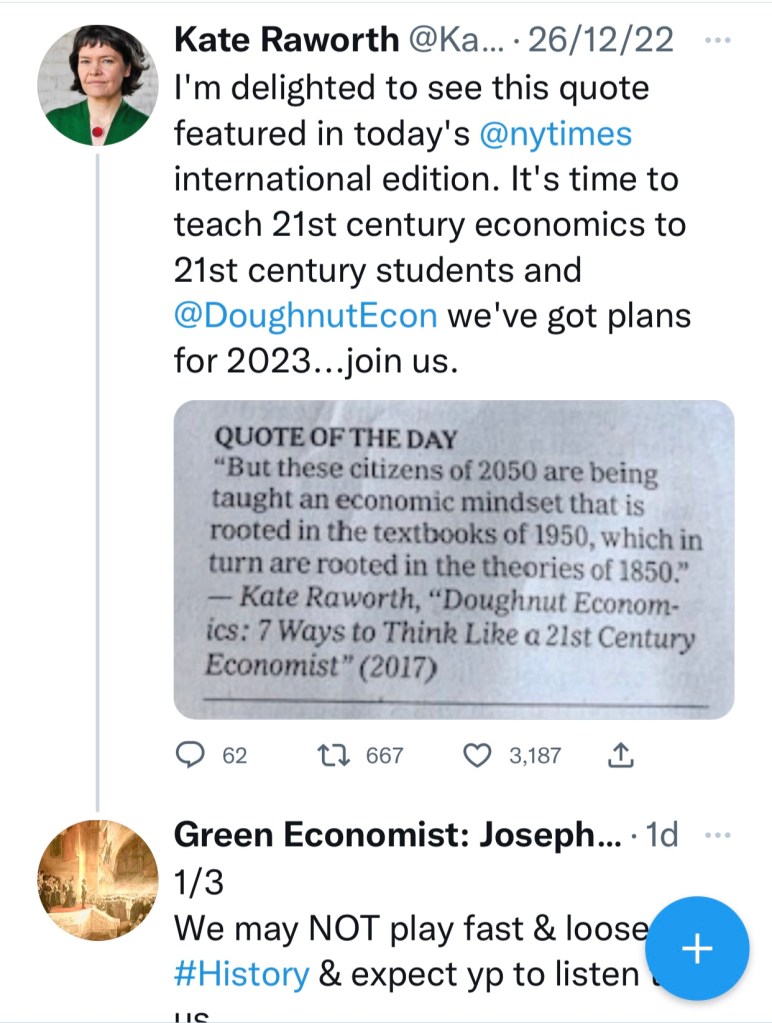
In a discussion with Kate Raworth and the friends of Donut Economy the question arose as to “1950 textbooks” (Samuelson’s and others right up to R Lipsey & S Holland & into this century, you would say, representing the whole competitive comparative-advantage extractive-exploitative foreign investment & dysregulated (“free” for capital-movers & owners, radically less so for everyone else and utterly catastrophic for global ecological health = liveable habitat for humans, other animals, birds, fish, phytoplankton, insects, mycorrhizae & all microbial life-forms) global economics OR 1850s textbooks.

So I delivered a firm but fair reminder of Smith’s original formulation of ‘executive washroom leaky plumbing’ trickle down to the toilers-at-screens on the floor below who would indeed be blessed with “opulence” for their good works, he wrote in 1776..

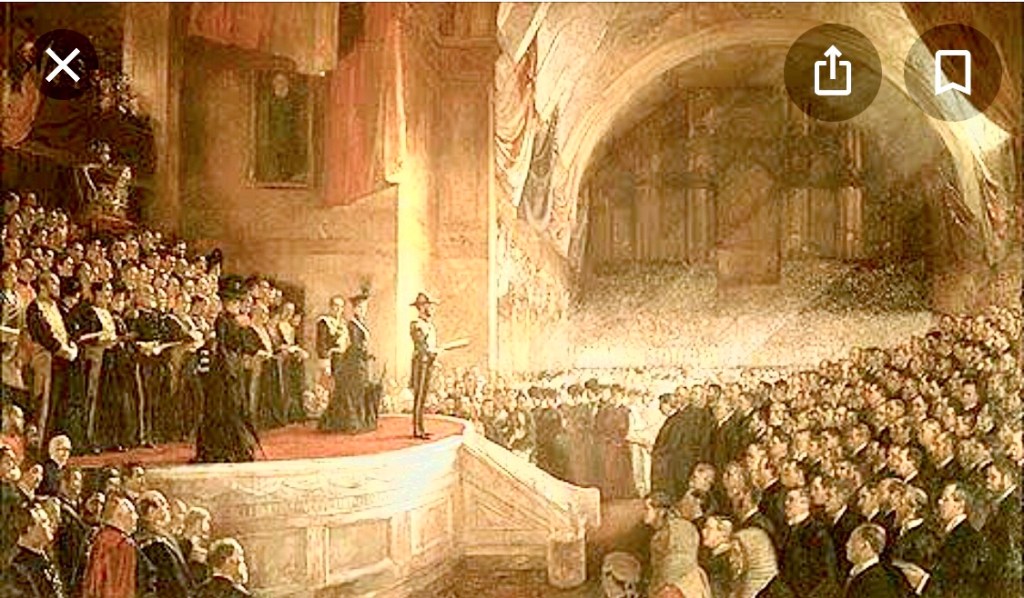
Then today, I was reminded by this lecture hall (pic) of my maternal grandfather as a young man at the time of the foundation of the South Australian Labour Party, its executive apparently all bearded besuited Cornish Methodist men from ‘The Burra’ and Moonta Mines*, of Workers’ Institutes & community libraries, of the foment of scholarship and industrial workers’ education across the country principally and pivotally on economy – what it is, how it works and above all other considerations how working men must strive against the contempt for them of bosses… imagining again as I have several times earlier, reading his books (I have two – there were several epochal tides-of-history others stolen, like ACV Dicey’s The Law & the Constitution, when I suffered a fraudulent family bankruptcy scam in 1998) how understandings of economy re-shaped and nearly upturned the geopolitical world through THOSE Noughties, ‘teens, 20’s and, gulp, Thirties.

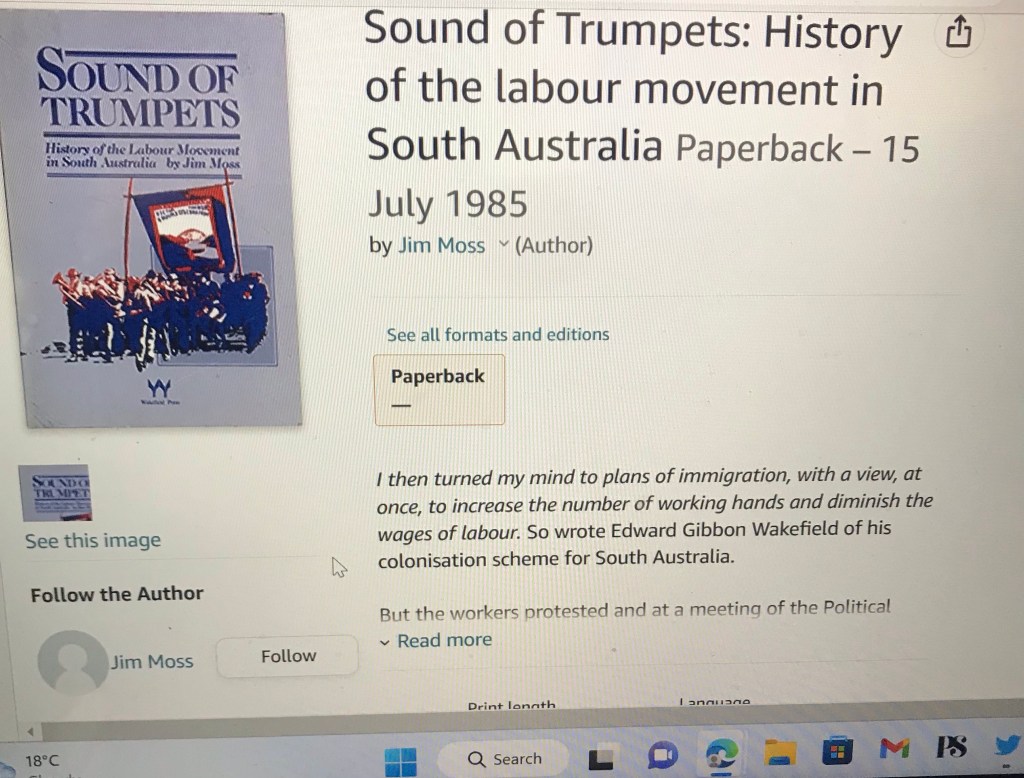
Please note in the summary of Jim Moss’s book how the very foundation of South Australia as a British colony was explicitly conceived by its greatly celebrated proposer Edward Gibbon Wakefield as “increas[ing] the number of working hands and diminish[ing] the wages of labour,” this sharply distinct from the line now five generations of South Australian schoolkids have been fed that the state was “the only one..” (tah-rah, there’s that Biblical sound of trumpets for us again) not dependent on British convict labour for its new roads, bridges & buildings.

So to return to topic – ‘textbooks of the 1950s rooted in the theories of the 1850s..”

So here’s Mr and Mrs Marshall’s sortie – beginning 1879 with “Economics of Industry.”

Grandpa Alexander Charles Lancaster Sanders’ “Industry” was the 1908 edition I think. “Principles” first out in 1890, was republished frequently. They were certainly used all over Australia in the 1890’s – 1914 period, and then on into the post WWII 1950s, when we were all swept up in the Marshall Plan Lend Lease IMF World Bank Paul Samuelson era… and on into the destructive orgiastic supply- side & business profiteering global frenzy we find ourselves muddling and fooling about with well into the third decade of the 21st century.

If we get our historical dates & links up to scratch then we will not slip back to slogans, throwaway lines, the solecisms and outrageous neofascist lies of the global newsmedia dumbdown, patronising infantilising ABC committee on spoken English absurdities like ‘scramble-ing,” maliciously confusing obfuscatory Gruaniad\ Guardian neologisms of acronyms (cop that you vacuous economically-irrelevant leafy-suburb Gen Y hipsters), the spasms, outbursts or indeed masculinist spurtings of late-adolescent revolutionary or Mom’s Basement fervour, or indeed any 1890s Oxford Union English ruling class Kenneth Graham, Lady Ottolene Morrell, Matthew Arnold “Culture & Anarchy” City of London tosh..

Occasional ringing phrases, biting metaphors and rhetorical flourishes are of course welcome. Just imagine you’re doing a sermon or your weekly segment at radio station 5DN in Tynte St, North Adelaide, whee-hoo.

Cool 😎

John, South Australia 🇦🇺

  • ” Sound of Trumpets: History of the labour movement in South Australia,” Jim Moss 1985