..the following being strictly, faithfully & scruplulousy reproduced for English language text & general Communications-production studies (urgent educational reform) purposes from The Antipodean Laboratory: Making Colonial Knowledge 1770 – 1870, by Anna Johnston University of Queensland Centre for Critical and Creative Writing.. Faculty of Humanities and Social Sciences, excerpts ‘4ROM’ pages 221-225
Note: Billionaire Monkeys with Olivetti Group @MIT Typewriters’ document title is comic though like every word, sentence and paragraph of our text on the record historically factual.
I found the fabulously apposite to serious active human scholarship Persuasion quote in an afternoon’s study at the State Library of South Australia ten years ago.
Creating Colonial Readers and Imperial Networks ☞
Political problems could be managed over dinner, too. When members of a committee of inquiry into the Orphan School arrived in 1842, Jane Franklin entertained two of the reformist convict-ship surgeons who had been charged by Elizabeth Fry to check on conditions for female convicts and their children. Jane Franklin, notoriously judgemental of convict women, assured Dr Dunn and Mr Nain over dinner of her deep interest in convict welfare and organised a personal inspection tour for Dunn to the Female Factory. She targeted Nain over dinner, taking ‘some pains to impress him with my views of things since he is likely to be on the board of investigation. Jane Franklin’s dinner party diplomacy was highly effective, if not subtle, in managing the Franklins’ reputation locally and globally.
The publication of the Tasmanian Journal ignited intercolonial rivalries. The Sydney Herald compared it favourably to a publication from an English provincial town: ’emanating as it does, from the press of Van Diemen’s Land, and from a Scientific Society there, it is still more wonderful’. The paper uncomfortably noted that Sydney ‘as the Southern Metropolis’ might instead have been expected to have produced the first scientific society and journal of record. The Port Phillip Gazette declared the Tasmanian Journal to be very creditable, but used the opportunity to spruik an intended publication The Melbourne Magazine, spurring its colonists to to produce a rival ‘in emulation for the literary fame of Australia Felix’. So, too, Jane Franklin’s Ancanthe museum was ahead of its time in its vision of engaging the colonial public. The ‘vineyard of literature’ that had produced the Tasmanian Journal was distinctive and based in the robust Tasmanian print culture as well as marked by the considerable, if controversial, influence of both Franklins.
The Platypus Journal and the Felon Print Press.. 1820s-1840s
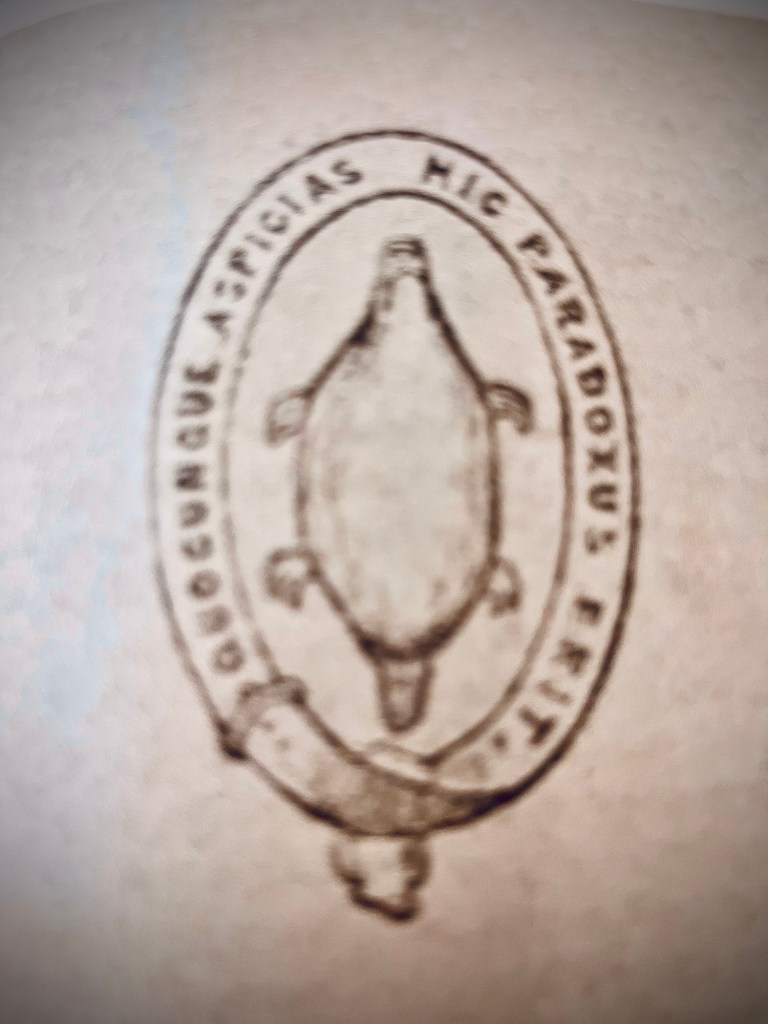
At a large dinner party at Government House in August 1841, Franklin’s personal secretary, Francis Henslowe, artfully arranged the dinner table with the first edition of the Tasmanian Journal. Jane Franklin approvingly noted the copies were perused by ‘the ladies as well as the gentlemen with much curiosity and interest’. Sir John Franklin fondly called the Tasmanian Society’s publication the Platypus journal. Like the famed Ornithorhynchus anatinus, rumours of the journal were considered a hoax by sceptics such as Sir John Pedder. Pedder and the solicitor Robert Pitcairn expressed their delight when copies appeared on the dining table. The platypus was a fitting visual symbol that graced the journal’s title page, encircled by the single-sided surface with no boundaries that would be termed a Mobius strip in 1868 (Figure 6.2) with a Latin tag, Quocunque aspiucius, hic paradoxus erit: ‘Whichever way you look at it, this is baffling’, or, as Captain Parker quipped, ‘All things are queer and opposite here’.⁴⁶ Both the frame and the animal had been deemed impossible in European theories of nature. For Jane Franklin, Parker’s phrase became useful to explain everything from black swans to the colony’s erratic postal system; more broadly, it also became metonymic of perplexing knowledge produced through colonial science. ..
It was also a durable textual artefact that Sir John and Jane Franklin used as an intellectual carte-de-visite. Jane’s determined focus on its production concentrated the attention of busy members of the society.. saw the journal as her particular property, Alison Alexander suggests, soliciting papers ‘without consulting existing members, “considering myself invested with a general commission” ‘. .. Little situated the initiative within the broader contexts of scientific association and publication. The journal was efectively the ‘ “Transactions” of the infant Philosophical Society of Tasmania’, but Lillie disavowed its members’ pretensions to be philosophers ‘in the modern acceptation of the term’. Society members were characterised as sincere and passionate amateurs, labouring under the disadvantage of distance from the institutions and leaders of science in Europe. They were motivated to communicate the outcomes of their leisure-time scientific activities and thus, by example, to influence colonial society in ‘a salutary direction towards liberal and scientific pursuits’.
The journal’s scope included zoology, botany, geology, and meteorology, aiming, over a number of years, to publish a full account of Tasmanian flora and fauna. .. – again, Sir John’s contacts were invaluable, as his mail often contained new scientific publications. The journal heeded Matthew Friend’s admonition about colonial speculations on ‘dubious and undetermined questions of theory’: instead, it aimed to be ‘a trustworthy repository of well-ascertained facts’. Some of the utilitarian knowledge it produced was directly applicable in exploiting natural resources in agriculture, geology and botany.
JB
Thematics 2-5set series logic, Neurocognitive Health, Child Moral Development, Education Reform, Economy, the Human (isation) Project, in general teaching ALL, everywhere, of the fundmental mental distinction AND indispensable dynamism beyond age 11yrs of macro (reflective or ideational signifiers or no-things) and micro see-hear-taste-smell-touch supply-siders’ commonly marketed crap and staying well
⁴⁶ Franklin, ‘Lady Jane Franklin’s Journal: Van Diemen’s Land Vols. 8 and 9’, January 1842; see Moyal, Bright and Savage; Moyal, Platypus
⁵⁶ For example, the meeting on 6 November 1839 heard Sir John reads ‘a portion of Captain Washington’s last letter … relating to Dr Chotoley and his Australian Vocabulary, also Mrs Whiwell’s letter relating to the tidal phenomena at Port Arthur, when Sir John related the means which had been adopted to improve the observations made there, and an old letter of Mr Spence’s on the virtue of keeping large meshes for keeping off mosquitoes and flies,’ Lady Jane Franklin’s Journal: Van Diemen’s Land Vols. 3 and 4
 Billionaire-🙈🙊🙉🐒s with Olivettis