My Lady D’Arbanville, why does it grieve me so?
But your heart seems so silent, why do you breathe so low, why do you breathe so low?
Consumer Advisory: excoriating acid Peter Sellers Bal-ham, Gateway to the South 2 style humour ☞ you might like to sit down OK ➜ The Tasmanian Journal of Natural Science, Agriculture, Statistics, etc. late August 1841 – 1849 Anna Johnston 2023 begin ?verso-recto page 214 at at-a-glance Level 4.7 (of 10 of course 9th century Kitab al Jabr Kurdish Persian Babylonian الجبر (al-jabr), your Fecunt bedtime Mood-meter Crescent read-out or some such post Global Human Deskilling Project ‘AI’ Prescriptive-text classical cocko.
GEA Monkeys again thank Anna Johnston University of Queensland Australia – only criminal scumbag plagiarist true Marxian societal parasites and the heirs & successors of Euro-amer-aus Belle Epoch flaneurs or boulevardeiers profit from the republication of her writing per MINE ➪➪➪ CEP Worldwide 1996 Information shall be free refers.

Due to his success in 1820s Arctic exploration, Sir John Franklin was lionised within ‘arctic circles’ and embedded in highly influential networks of knowledge, exploration and science9. Franklin was part of a scientific social world that forged professional as well as personal relationships, including marriages between elite families. … John’s first wife, the poet Eleanor Porden, while his second wife, Jane, became adroit at managing the scientific and government networks that surrounded her husband10. The period of the Tasmanian Journal provided an opportunity for Jane to observe her husband’s correspondence networks with learned gentlemen with political influence – and develop her own voice and interests within those networks – that would underpin her later, tireless advocacy following Sir John’s disappearance on his final Arctic voyage after his ignominious recall from Van Diemen’s Land.
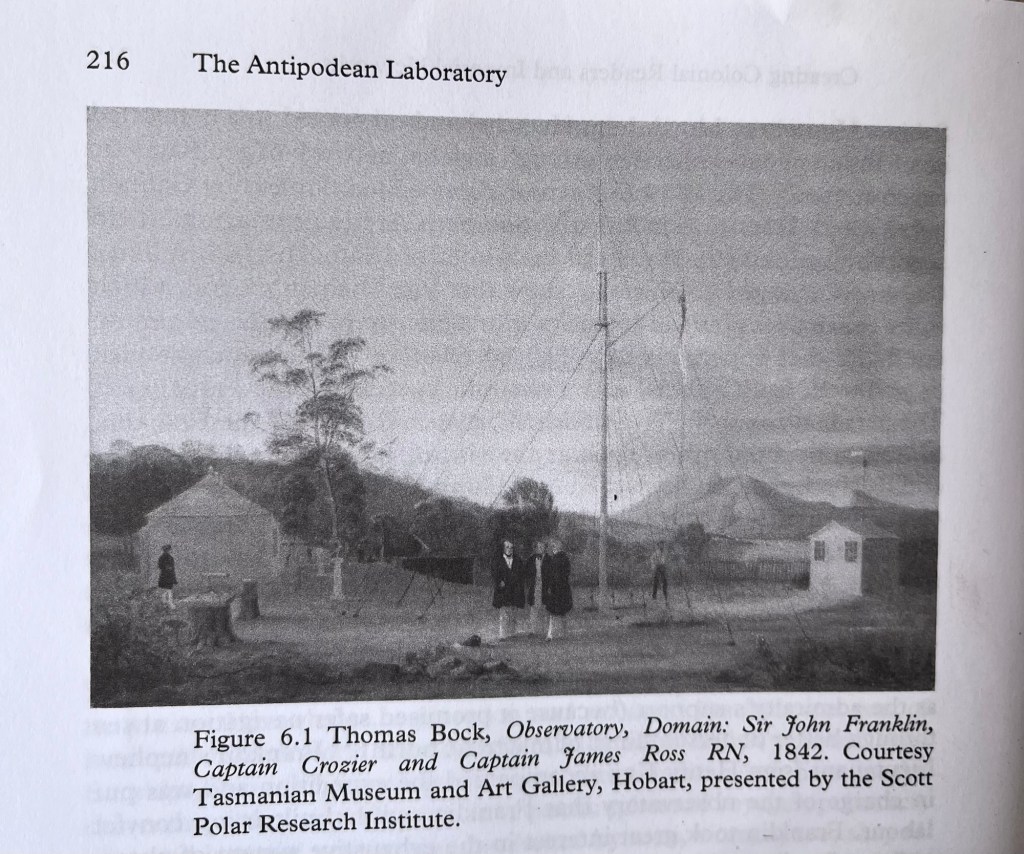
The 1830s saw new directions in British science that made the Franklins’ tenure in Tasmania particularly valuable to the advancement of knowledge. The ‘Magnetic Crusade’ successfully advocated by Edward Sabine, Humphrey Lloyd, John Herschel and others led to a concerted acceleration of data collection through a global network of geomagnetic observations11. The 1839 Erebus and Terror expedition led by Captain James Clark Rose to establish the Southern Arctic geomagnetic field spent three months in Hobart in the winter of 1840. The Hobart Town Courier encouraged colonists to ‘show that Van Diemen’s Land, which is the maximum point of intensity in magnetism is not the minimum one in all that appertains to the social relations of life’, and the visit proved to be both a social and a scientific success to the Franklins12. The personal connections established between Ross and John Franklin, as well as between others such as the visiting botanist Joseph Hooker and local scientific enthusiast Ronald Gunn, underpinned years of later correspondence on scientific matters, and colonial and imperial politics.. joint scientific and strategic.. pure and applied aspects that ensured the support of the Royal Society (because the massive data collection promised to lead to principles that might join laws of terrestrial magnetism to ‘cosmical’ theories of the earth’s field) as well as the admiralty’s support (because it promised safer navigation at sea through better understandings of magnetic north)13. Franklin’s nephew Lieutenant John Henry Kay accompanied the expedition and was put in charge of the observatory Franklin swiftly built using convict labour. Franklin took great interest in the exhaustive system of observations, funding and appointing additional men when the first technicians were overwhelmed by the process; he also advocated for their promotion through the admiralty. He reported regularly in his letters to Sabine, Ross and others about the local contribution made the Tasmanian magnetic observatory. Jane Franklin named the facility Rossbank and commissioned a portrait of it by convict artist Thomas Bock as part of Franklin’s vision of the interconnected, improving cultures of arts and sciences (Figure 6.1)14
The Franklins’ role in this well-regarded global enterprise was undoubtedly motivated by scientific factors, but John Franklin was also aware that his support kept open strategic communications channels that could be used to pursue his political interests in London while he was in Hobart … national rivalry between Britain and France in the geomagnetic field. The geomagnetic campaign was central to the establishment of the British Association for the Advancement of Science (1831), a crucial part of British ambition and scientific nationalism that also led innovation in science communication. Remote colonies had a significant role to play in establishing British leadership in these observational sciences, which had important political and economic objectives, in addition to their intellectual prestige.
The Tasmanian initiatives joined efforts in other Australian colonies. The Philosophical Society of Australasia was established in Sydney in 1821 as an exclusive cadre of gentlemen with a general interest in science. …
Rumker and Brisbane’s observations from New South Wales were sent to influential international journals, societies and collaborators. Yet personal enmities and colonial politics stymied lasting local scientific outcomes21. The Sydney Philosophical Society was short-lived, and Brisbane’s ambitions to bring ‘the Science of Political Economy’ to Australia were thwarted. .. John Franklin revived the Mechanics Institute in the late 1830s, but because Franklin rarely attended meetings the institute languished26 Each of these experiments with associations created the conditions for local scientific publication, but did not coalesce until the Tasmanian Journal appeared in 1841. …
..John Franklin described it as ‘a little private scientific society consisting only of half a dozen individuals which meets every fortnight in my library to read papers and converse. It is without name and seeks to hide itself from public notice27. Members included key colonial officials, such as the treasurer Adam Turnbull, who had reported on the 1830 visit of Captain Matthew Friend. Science was linked to the nascent school system, represented by.. principal of Queen’s Orphan School, and.. The Presbyterian minister Revd John Lillie provided the moral authority for science.. Francis Henslowe, who was also John Franklin’s private secretary at Government House. … Visiting officers with interests in science and exploration were made corresponding members, such as Dumont D’Urville (the French rear admiral and gifted natural scientist whose second Antarctic voyage was launched from Hobart in 1840) and the Erebus and Terror officers Ross, Hooker and James Robertson. So too John Gould, who, with his wife Elizabeth, stayed with the Franklins for a considerable time.. ‘Count’ Paul Strzlecki, as well as Alexander Maconochie and the Revd Thomas Naylor, then both at Norfolk Islandᵛᵛ.. the interests of the society and the ambitions of Jane Franklin..29
Footnote14 was it uh
John Blundell
🦘⌨️🥸🌐
*/1 a sacrifice in which the offering was burned completely on an altar.
2 The “best seller” by Peter Sellers released in 1958 was his first studio album, a comedy LP titled The Best of Sellers.
9 see the excellent doctoral thesis by Annaliese Jacobs, ‘Arctic Circles‘
10 Jacobs, ‘Arctic Circles‘
11 Cawood, ‘Magnetic Crusade‘
12 Savours and McConnell, ‘History of the Rossbank‘, 533. On Jane Franklin’s role in maximising the social and intellectual influence of the Ross expedition in Tasmania, see Alexander, Ambitions, 114-16
13 see Cawood, ‘Magnetic Crusade‘, 494-96
21 Field, Geographical Memoirs. Field also published the first book of poety in Australia, First Fruits of Australian Poetry (1819)
26 See Alexander, Ambitions, 109
27 John Franklin to Francis Beaufort, 17 February 1840, in Franklin, ‘Lady Jane Franklin’s Journal: Letters to Mary Simpkinson‘
29 Franklin, Lady Jane Franklin’s Journal: Van Diemen’s Land Vols 3 and 4, 18 May 1839
^^ readers of “@wired4weld“\ greeneconomyaction.com may be kind enough and sufficiently earnest & dogged in their studies (reading) to inspect our 9/12 and 10/12/ 2025 pieces – Where sYDNEY cOVE.. and Cadwallader having Sex.. OK
 Billionaire-🙈🙊🙉🐒s with Olivettis