That Twentieth Century sure was a zinger for our universities and professors and shit.
READER NOTE
You might be persuaded a child who spent five ➡ every day (s) of the week – barring special little tours around the ex 1850s City of London colonial province of South Australia (his dad being a gun mechanic and traveller) on the premises of country general hospitals (regulated by the Sth Austrln government Hospitals Department no less..
remember this was the Australian state that by the agency of its Education Department i think in1870 but dates are rubbish and don’t count any more that’s just the way human history, counting ‘shit’ – guhna – producing utterly nonsensical artificially compartmentalised (obscenely siloed) or arbitrarily sectorised Doctors of Philosophy theses & cockamamie studies/ D movies on the affairs of Great Men has (bed-) panned out, right, gave you all the rousing sublime ‘Thousand dyes’ Song of Australia..
iah- iah- ia-a-A-A-aa
and subsequently his entire teenaged years plus two waking up every morning (other than during brief excursions-out of up to a week or two) on the same property and premises of a virtually fully Commonwealth of Australia funded and AustralianTaxation Office rorted ‘to the proverbial back teeth’ private 4 profit sector Nursing Home, who subsequently moved to an 18 year career in both federal and state human services (‘social’) policy delivery, development and government advisory followed by enquiry duties during the Hawke period would know a bit about mental illness – not to mention its flipside in a dialectically bonkers world of light & darkness that catastrophically forgot to study heat & cold – mental health.
You’d be right about that.
“Edvard Munch Was Haunted by Physical and Mental Illnesses—but He Was Also Fascinated by Them”
Known as the painter of “The Scream,” the Norwegian artist and his loved ones spent many years suffering from health conditions. A new exhibition explores how the world of medicine influenced his art..
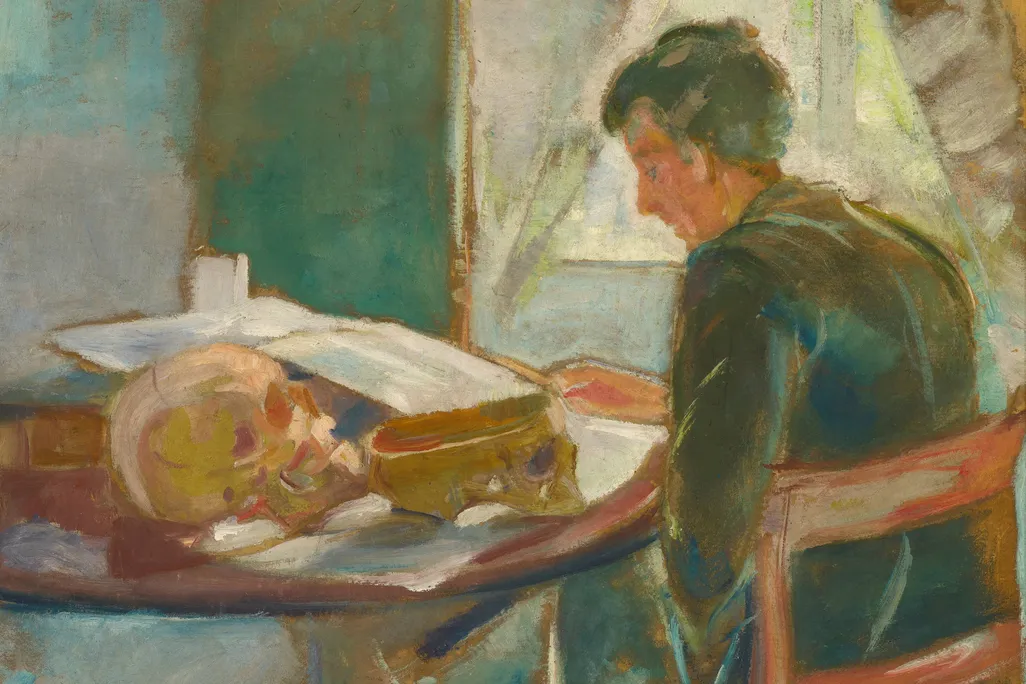
The Norwegian artist Edvard Munch was well-acquainted with the world of medicine. He was the son and brother of doctors, and he suffered from medical and psychiatric illnesses throughout his lifetime. These experiences informed his depictions of ailing bodies and minds.
“Lifeblood: Edvard Munch,” a new exhibition at the Munch Museum in Oslo, explores Munch’s fascination with illness through paintings and artifacts. The show examines not only the artist’s life, but also the history of medicine in the late-19th and early-20th centuries.
Quick facts: Why did Edvard Munch paint The Scream?
- The painting was inspired by a walk the artist took with two friends in 1882.
- “My friends walked on, and I stood there trembling with anxiety—and I sensed an infinite scream passing through nature,” he later wrote.
“[The show] allows visitors to explore the history of healthcare through Munch’s powerfully expressive work, to feel and reflect on our bodily vulnerabilities, and to better understand our persistent quest for health,” says exhibition curator Allison Morehead, an art historian at Queen’s University in Canada, in a statement from the museum.
Born in Norway in 1863, Munch is known for his paintings that explore psychological themes, such as The Scream. But some of his earliest artworks depict mundane medical matters. He spent much of childhood in poor health, and he sometimes ran errands for his father, who was a doctor. When he was a young teenager, he painted small watercolors of medicine bottles, some of which are included in “Lifeblood.”
Munch’s loved ones were also plagued by illness, which provoked his fear—and inspired his art. As Mai Britt Guleng, a curator at the National Museum in Oslo, told Scientific American’s Jan Dönges in 2021, “There [were] hereditary diseases in Munch’s family—mental, nervous illness and tuberculosis. … Munch and his siblings were worried about this.”
/https://tf-cmsv2-smithsonianmag-media.s3.amazonaws.com/filer_public/c9/a9/c9a9b9ae-5658-44a5-9db5-5de1ec521552/medisinflaske_og_skje.jpeg)
Munch’s father struggled with depression, and his sister Laura spent time in a psychiatric ward. Meanwhile, his mother died of tuberculosis when he was 5, and his older sister Sophie perished from the same disease when he was 14. His sister’s death inspired his 1886 portrait The Sick Child, which depicts a pale girl with red hair. Munch’s brother Andreas also died of pneumonia as an adult.
In 1919, Munch was 56 when he contracted the Spanish flu, which was ravaging Europe. During this period of illness, the artist painted Self-Portrait With Spanish Flu, which shows Munch staring toward the viewer, struggling to breathe. In the exhibition, this painting is displayed beside the equipment Munch used to help him breathe during his illness.
/https://tf-cmsv2-smithsonianmag-media.s3.amazonaws.com/filer_public/fb/41/fb41ad51-65cd-45e1-8188-52ab8e9ab302/livsblod-11_1.jpeg)
Also on display is a piece called On the Operating Table, which depicts a man surrounded by doctors, nurses and an audience of observers during surgery. This painting is connected to a violent encounter between Munch and his fiancée in 1902, which left him with a bullet wound in his hand. According to the Art Newspaper’s Louisa Buck, experts aren’t sure who fired the shot, but the surgery he endured afterwards inspired the piece.
The exhibition displays On the Operating Table beside an X-ray image of Munch’s hand—a new technology at the time—in which a bullet can be seen in his finger. Other medical artifacts on view include glass sputum bottles, a baby incubator, stethoscopes, a nursing uniform and contraceptive devices.
/https://tf-cmsv2-smithsonianmag-media.s3.amazonaws.com/filer_public/01/5e/015ec1f7-3bad-4685-967e-8ba72c9bf7da/pa_operasjonsbordet.jpeg)
Munch’s work often reflected women’s health concerns, such as “melancholy, hysteria, syphilis, contraception, childbirth and infant care,” per the statement. Consider his painting Inheritance(1897-99), which depicts a coughing mother holding a sickly newborn. It was inspired by Munch’s visit to a Paris syphilis hospital, where he recalled watching a mother learn that her baby had been infected with the disease, according to the Art Newspaper.
“‘Lifeblood’ reveals a lesser-known side of Edvard Munch—where art becomes a vessel for the fears, hopes and compassion that surround illness and care,” museum director Tone Hansen says in the statement. “By intertwining Munch’s work with the history of medicine, this exhibition invites us to reflect on our own health and vulnerability in a time of deep uncertainty.”
“Lifeblood: Edvard Munch” is on view at the Munch Museum in Oslo through September 21, 2025.
You Might Also Like
- Edvard Munch Is Known as the Painter of ‘The Scream.’ His Many Haunting Portraits Show That He Was Much More Than His Masterpiece April 9, 2025
- See How Modern Artists Obsessed With Death and Darkness Looked to Medieval Gothic Artworks for Inspiration November 14, 2024
- Sixty-Four Stunning Artworks by Famed ‘Scream’ Painter Edvard Munch Are Heading to Harvard February 6, 2025
- ‘The Scream’ Gets a New Home in Norway’s $650 Million National Museum June 10, 2022
- This 13-Foot-Long Munch Painting Was Hidden From the Nazis in a Norwegian Forest January 23, 2023

Sonja Anderson | Read More
Sonja Anderson is a writer and reporter based in Chicago.
Get the latest stories in your inbox every weekday.
Email Powered by Salesforce Marketing Cloud (Privacy Notice / Terms & Conditions)Edvard Munch Was Haunted by Physical and Mental Illnesses—but He Was Also Fascinated by Them
Known as the painter of “The Scream,” the Norwegian artist and his loved ones spent many years suffering from health conditions. A new exhibition explores how the world of medicine influenced his art
/https://tf-cmsv2-smithsonianmag-media.s3.amazonaws.com/accounts/headshot/Sonja_headshot.png)
Sonja Anderson – Daily CorrespondentJuly 18, 2025
☹☺️☹☺️☹☺️☹☺️☹☺️☹☺️☹☺️☹☺️☹☺️☹☺️☹☺️☹☺️☹☺️☹☺️☹☺️☹☺️☹☺️
Read, listen, converse. heal, learn, grow.. write
the unofficial two micro-behavioural and two ideational mental constructs (macro) of human empowerment we nutted out under the guidance of the late Connie Benn and John Tomlinson on the fringe of the Australian Council of Social Service national conference of Sepotember 1978¹
John Blundell
The global humanisation project Australia
Neurocognitive Health
Quantum-relations 2 – 5 set series logic
Immediate reform 25,000 universities worldwide
Economy
Ma-thematics Neurolinguistics Standard Ψ spiritual social relationships Cultural Studies
21072025

¹ readers may be assured I actually went to Sydney once, entirely at my own expense though the tax deductions helped
¹ᴬ rumours he will visit Canberra, ACT, for the first time “any time soon” have no basis in fact
 Billionaire-🙈🙊🙉🐒s with Olivettis