..this is a bunch of notes really. At this truly awful moment in post-feudal heraldic geopolitical history when we have plagues of diseases old & new, food insecurity/ starvation, a global engineered literary AND scientific deskilling DUMBDOWN and the monumental assault not any longer on low income people (they’re all broke mostly displaced) but now with the aid of fancy apps and artificial “intelligence” troll-botting the middle class – except of course for its upper echelons for they are the people who OWN the so-called Information Economy, who make & break governments, the new untouchables and frankly halfwitted virtual knuckle-dragging ahistoric influencers or performing artists (you what? Seriously??) AND AN ECOLOGICAL COLLAPSE THAT NO NEWSPAPER OR TV NEWS EDITOR EVEN GRASPS for Christ’s loving sake.
..who even in his or her or their right minds even wants to know about geopolitics – or is able to dutifully watch, zombie-like (are the poor sods?) this Greed Lust Laziness Ambition & Manly Thrusting Sinophobe Islamophobe geopolitics shit anyway? Who can watch it? Or the speech of B Netanyahu, his zombie-warriors and mesamphetamine or cocaine-inflamed copywriters??
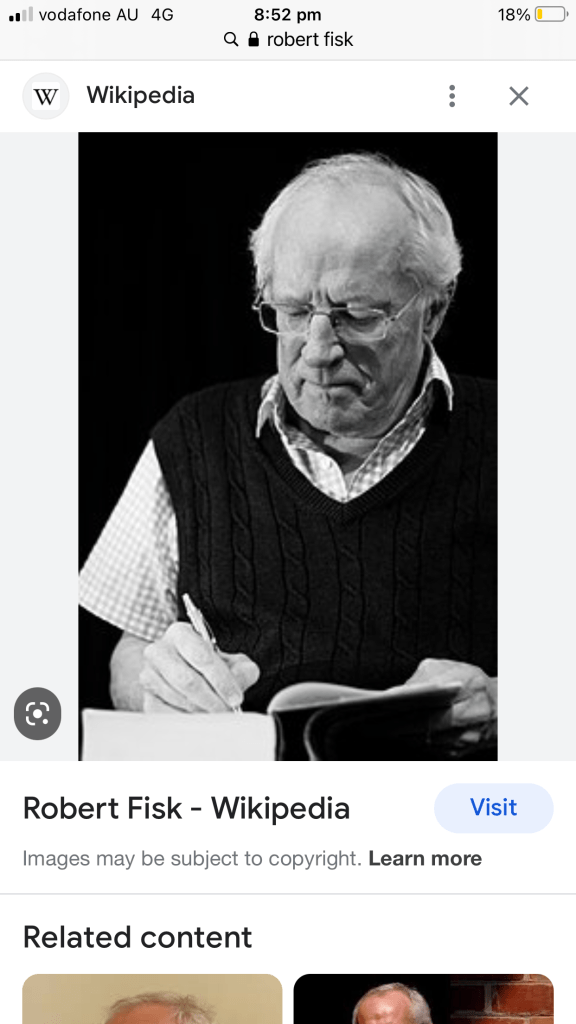
THE OLD MANDATES,, Under the 1919 Treaty of Versailles, Britain and France, the principal victors of the First World War, received mandates from the league of Nations to govern most of the Levant. The British were given Palestine, Transjordan and Iraq; the French received Syria (and initially, northern Iraq). The French government tore off the south-west corner of Syria and created the state of ‘Greater Lebanon’. Robert Fisk lived in Beirut from 1976,[25] remaining throughout the Lebanese Civil War. He was one of the first Western journalists to report on the Sabra and Shatila massacre in Lebanon,[26] as well as the Hama Massacre in Syria.[27] His book on the Lebanese conflict, Pity the Nation, was published in 1990.
Please also see the second part of this essay: Robert Fisk: From Beirut to Damascus, published by the Euro-Gulf Information Centre
1. Robert Fisk writing for The Independent, 5th March 2005..
“I’m sure this applies to the old Afghan Airlines jets when they were flying under the Taliban. Back in 1997, I was on my way to Afghanistan – to see Osama bin Laden, no less – and could only find a flight to Jalalabad from the old Trucial state of Sharjah, a home for pariah aircraft like the old Boeing 727 that was waiting for me on the runway. On boarding, however, I found that only the first row of seats remained in place. The rest of the aircraft was taken up by large wooden boxes containing ‘mechanical imports,’ according to the crew, each heavy crate chained to the floor of the plane. Even more trouble was the forward lavatory. For only minutes after takeoff, the door opened of its own accord and a dark tide of sewage slowly washed over our shoes and then surged down the cabin. I didn’t feel like an in-flight meal. I was sitting next to two Afghans, the second of whom – vastly bearded to abide by the Taliban’s tonsorial rules – was dressed only in jeans and an open-necked shirt and who kept glaring at me while squeezing and resqueezing a large and very dirty oil rag in his left hand. Over Kandahar, we flew into heavy turbulence, the plane bucking about, the chains clanking as the wooden boxes tried to move across the cabin, the tide of sewage revisiting us from the forward lavatory. It was at this point that the purserarrived at my seat. ‘Mr Fisk, you are our only passenger and you have no need to worry about safety,’ he said. ‘You see, you have the honour to be sitting’ – and here he pointed at the bearded hostile figure at my left – ‘next to our senior flight engineer.’ “
[A dubaious tale indeed – imagine sitting next to an industrious @IPCC_CH researcher in December 2023! Anway that was fun so here’s one more from the same ‘Independent’ article..]
“It began when I endured a crash landing at Tehran airport just after the Islamic revolution. The front wheel failed to emerge from its pod before landing – for aerobuffs, it was a Boeing 737, but Iran was now under @UN sanctions – and the plane came down with the biggest bang i have ever heard in my life. No lives were lost. But almost immediately afterwards, the fuselage filled with thick clouds of blue smoke, which – I realised after a few seconds – was every terrified passenger lighting cigarettes at the same moment. I returned to Beiruit with the worst case of flying fear in the history of the world.
“Fortunately, I knew every pilot then working for Lebanon’s Middle East Airlines – they were flying the mighty old 707s in those civil war days – and one of them immediately told me to turn up next morning for a series of Boeing test flights out of Beiruit airport in stormy weather. He sat me down behind his pilot seat on the flight deck, poured me a huge glass of champagne, strappped earphones onto my head and took off into the kind of turbulence seen only in the movie The Day After Tomorrow. He flew the empty airliner over the desolate, frothing Mediterranean, turned around, landed on runway 1 – 18, took off again into the storm, landed and went on and on – each takeoff accompanied by another glass of champagne – until, after 14 take-offs and landings, I was giggling like a baby. I never lost my fear of flying – but I no longer believed I would die every time I boarded a plane.
“Deep down, of course, like almost everyone I know, I don’t believe in powered flight. I simply do not accept that it is natural to tie oneself to a seat in in a metal tube and hurl oneself into the sky at 500 miles per hour for seven hours, with or without a gin and tonic. And I have come to realise that I employ my old friend, the suspension of disbelief.”
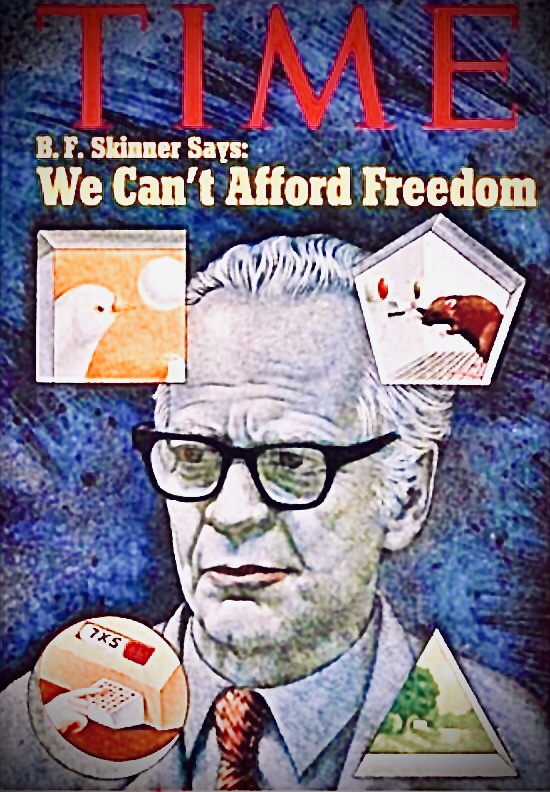
[And here the lesson seems to be the ubiquitous post WWI and particularly II American alpha male big noisy machines BF Skinner CIA operation.. er, Operant Conditioning behaviour modification procedure commonly called ‘If you’ve got them by the balls their hearts & minds soon follow’ no but hang on it’s obviously the flipside in this instance ‘Give them pleasure and they’re yours for a song.’ STUDENTS may like to work up an exciting #ChatGPT report feeding in the big binary Pleasure-pain (war-peace, black-white, donkeys-elephants, love-hate et cetera AND 20th century United States of America Foreign Policy. You may include red, yellow and brown people in the read-out, OK? I feel better now.]
2. Robert Fisk: From Beirut to Damascus by Romy Haber
Robert Fisk (71), a veteran Middle East reporter and author, died on 30 October 2020 in Dublin after a suspected stroke. Fisk was considered an expert on the troubled and dangerous region of the Middle East. He was famous, notably, for his work on Lebanon’s wars encapsulated in his famous book Pity the Nation (1990) and interviews with Al Qaeda’s Osama bin Laden. His works served the anti-war movements and he won accolades for his fierce critic of US foreign affairs in the Middle East. For many in the media sector a journalist-hero has been lost. However, many in the Middle East remember him differently.
Fisk, having been brought in by Edward Said’s Orientalism had, similarly, the tendency to elevate pan-Arabist and pan-Islamist concerns above those of the Middle East’s many minority communities. His book, Pity the Nation — much praised by Western journalists — especially in the pre-internet era, does not impress Lebanese readers. It stands accused of whitewashing the Palestinian Liberation Organisation (PLO), while taking a tougher stand on Lebanese Maronites:
‘The Maronites brought the war down on their own heads. The first event of the civil war was a massacre of Palestinians by a group of phalangists trying to win power.’
This statement shifts the blame to Maronites, who did not want their country to turn into a playground for foreign militias and guerrilla warfare and who were tired of being harassed at checkpoints by Palestinian militiamen in their own country. A few hours before the massacre Fisk was referring to, the PLO tried to kill Christian leader, Pierre Gemayel, but failed and instead they killed two civilians and two Kataeb members.
Fisk’s historical accounting was often accompanied by derogatory remarks and he had no problem calling an ethno-religious group ‘stupid’ or even justify their killing. In one remark, Fisk said ‘Is it any wonder that the Hezbollah headbangers now want to kill them all?’ In reference to the Maronite Christian minority in Lebanon. Defending and downplaying the killing of a minority (Maronite in this case) by a terrorist organisation is never ethical, even if it was meant to be sarcastic.
‘…suppose Robert Fisk had written the truth about the Islamic militancy? which is now at work in Lebanon: would he have been able to reside comfortably in the Iranian capital? Suppose he had, over the years, writing the truth about the Syrian occupation: would he have been able to claim that special expertise which attaches – he hastens to inform us – to those who can travel freely ‘North of Baalbek’ (i.e. into the zone occupied for the past ten years by Syria)? Or suppose he had written the truth about the Palestinians, whose lawless cohorts roamed the countryside of Lebanon, tormenting Shi’ite and Christian alike, and driving thousands from their homes, long before the Israeli invasion: would he have been able to enjoy the comfort, along with so many other Western correspondents, of a West Beirut hotel owned by Palestinians?’
What Fisk called ‘getting close to the truth’ usually meant getting close to authoritarian regimes and their intelligence services. However, whitewashing the Syrian government’s massacres in Darayya, Eastern Ghouta, Douma and Khan Sheikhoun was the match to the powder keg and he denied some of the most heinous war crimes of the 21st century.
Of course, speaking ill of the dead is not the right path. Fisk made some very important contributions to unpacking some of the more pressing issues that grip the Middle East. He worked hard and acted as a source of inspiration for many people in the region—not least the Palestinians. So, despite the controversies, Fisk was an influential correspondent and it is a shame that his track-record is speckled and his legacy is tainted. While it is better to remember people for their positive achievements, since journalists write the first draft of history, it is history itself that judges them and on this Fisk’s work needs to be understood.
Romy Haber, undated
John BLUNDELL
Economy, Human Health, 2-5 set Maths, the new Neurolinguistics, Philosophy of Science
South Australia 14th December 2023
🇺🇦
غزة
 Billionaire-🙈🙊🙉🐒s with Olivettis