Personal and political context:
greeneconomyaction.com acknowledges with thanks the ongoing contributions of Nature. This writer, a bona fide 30-year #climate scholar, knows and cares less than nothing about documents gathered under the rubric or preposterous post-fact legal aegis of @Nature_eco: self-respect, personal dignity & integrity and the limited number of working hours available to any of us who give a damn about the state of the world in my view DEMAND that economists and philosophers almost completely bypass the facile, turgid, cloying-beyond-absurd if not deranged anodyne Attenborough & Disney & National Geographic era junk environment information-product and rich-tourist greenwash spurting-from-the-proverbial-existential-ground of affluent~ Global North countries’ contemporary billion-dollar per year ooh-and-ahh publishing bonanza. Look, over there, a dead child-destroyer Pope, unicorns, kids-in-Yemen and General Mark Milley.. Look over here: Australia.
~ meaning in possession of surplus disposable income and therefore, in turn, ruthlessly targeted and/ or fleeced by corporations, banks and organised crime operatives analogous with the fictive medieval self-devouring priapic serpent-beast (Sigmund Freud eats his own heart out, yet again)
@nature-magazine CAREER FEATURE: “Classroom assistance: the scientists turning the tools of their trade to education” : ‘A small but growing number of scientific faculty positions are focusing on the science of teaching’

As a doctoral student at the University of Washington in Seattle, biologist Michelle Smith spent a lot of time sorting fruit flies under the microscope. But she often found her mind wandering to her teaching activities: assisting with undergraduate laboratory and writing courses, and instructing schoolchildren in physics and biology.
“I felt this real draw towards teaching, but I also liked research,” she recalls. She felt lost, until 2007, when she took up a postdoctoral position in education research with Carl Wieman, a Nobel-prizewinning physicist with a deep interest in science education, then at the University of Colorado Boulder. She’d found her dream position: using her research skills to investigate how peer discussions help undergraduates to learn basic genetics concepts. She published her results in Science1.
When she started her postdoc, Smith recalls, there weren’t many faculty positions available for education-focused researchers in biology departments. That’s changing, and she is now a tenured professor at Cornell University in Ithaca, New York, researching learning in ecology field courses, and senior associate dean for undergraduate education.Stop describing academic teaching as a ‘load’
Tenure-track faculty members with expertise in education research are starting to pop up in science departments at leading research universities — although this remains the path less taken. Their presence, position and prestige also varies widely by nation, institution and field of study2.
“There has been a growth in these types of position, both for tenure-track and long-term contract faculty members,” says Emily Miller, deputy vice-president for institutional policy at the Association of American Universities in Washington DC.
Precise data on the trend are scarce, but researchers from around the world point to the United States as a leader. The US National Science Foundation funds extensive research into science pedagogy, much of it through its Directorate for STEM Education, which doles out US$5 million to postdoctoral fellowships in science, technology, engineering and mathematics (STEM) education. There has also been a modest rise in a handful of other nations, including Canada and Australia, but they tend to have less money to support such studies, says Kimberly Tanner, a biologist at San Francisco State University in California, who focuses on biology-education research and co-edits the journal CBE—Life Sciences Education. The field has gained stature from the participation and support of big-name scientists such as Wieman and Tanner’s mentor Bruce Alberts. Alberts is a biochemist at the University of California, San Francisco, past president of the US National Academy of Sciences and author of the prominent textbook The Molecular Biology of the Cell.
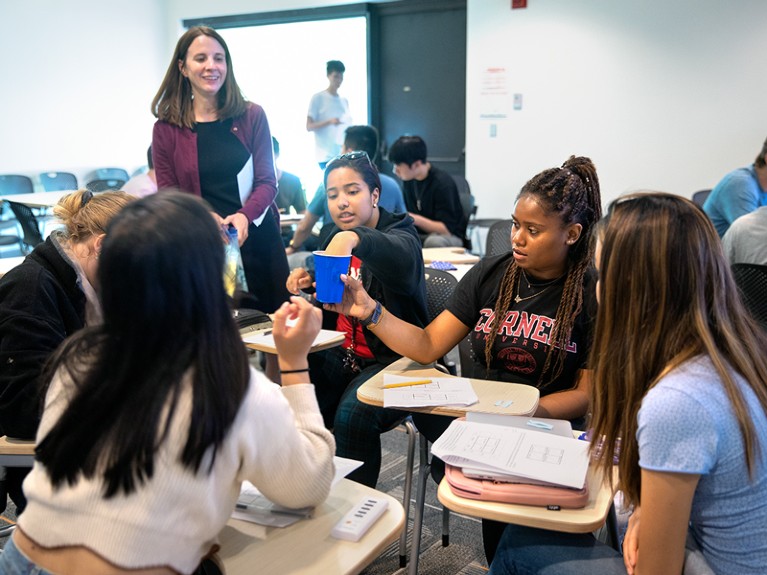
Faculty members in this speciality might largely teach, or they could maintain a strong research programme that focuses on education. “Within this field, you can think about the balance that you want, and you can have options,” says Smith.
Some researchers, such as Wieman, transitioned into education research after becoming established in their initial discipline. As the number of positions grows, early-career researchers will be able to enter education-focused positions directly. Faculty members who focus on education not only support their own students, but also help their colleagues to adopt the latest, science-based teaching methods, which in turn improves universities’ reputations with applicants.
Sideways steps
The discipline of physics has a long history of engaging with education research, says Wieman. His interest in education was sparked after starting his atomic-physics lab several decades ago, when he noticed that some graduate students who excelled at physics courses in the classroom were not as successful when they embarked on research in the lab. They were book smart, but lacked the problem-solving skills to debug scientific equipment or interpret experimental results. “There was just this fundamental puzzle,” he says. “Why were these things so disconnected?” So, for the next 15 years or so, he led parallel research programmes in atomic physics and physics education.Better teachers are needed to improve science education
The atomic-physics programme earned him a Nobel Prize in Physics in 2001, and that also gave him a “bigger soapbox to stand on” to advocate for improvements in education. In 2007, he moved to the University of British Columbia in Vancouver, Canada, where he set up a Can$11-million (US$8-million) initiative to transform undergraduate science education with evidence-based methods, while managing a similar initiative in Colorado.
Wieman says that, rather than relying solely on lectures, teachers should facilitate “learning to think in a different way, and there’s real expertise in how to guide people to do that”. Many education experts promote active-learning techniques, such as getting students to work together to solve problems. More than 100 courses at the University of British Columbia were altered as a result of Wieman’s initiative3.
Wieman now has a joint appointment in the physics department and at the Graduate School of Education at Stanford University in California. Today, his research focuses exclusively on education, and specifically on undergraduate education of ‘technical expertise’ in physics, engineering and medicine.
Biology is another field with a history of education research, but it has taken time for many departments to prioritize educational innovation. In 1999, when evolutionary ecologist Raoul Mulder was interviewed for his first faculty job, a standard teaching and research position at the University of Melbourne in Australia, he recalls being asked only one question about lecturing.
As Mulder’s studies of bird ecology progressed, he, too, became intrigued by educational methods. “I think teaching is an absolutely natural outlet for this curiosity we all have as researchers,” says Mulder.
He began to turn the tools of science on education. He describes his initial education research, which began in the early 2000s, as “kind of a side hustle, I suppose. I wasn’t sure whether it was an accepted part of my identity”.
One of these side interests was student assessment. He noticed that students often didn’t pick up their final papers after grading. His careful feedback came too late to help them to improve their grades. So he experimented with a system wherein students received feedback from each other ahead of final submissions. Not only were the final papers improved, but students often couldn’t tell the difference between comments from their peers and their teachers4.
As these side projects continued, Mulder accumulated education-focused grants adding up to nearly Aus$1 million (US$675,000). Although his education studies account for only about 10% of his papers, they fuel more than 20% of his citations and make up nearly half of his top-ten most-impactful citations. “What was a side hustle has actually become more important than I thought,” Mulder says.Improve undergraduate science education
It also marked him as someone interested in education studies, and in 2021 resulted in him taking on a leadership role at the Melbourne Centre for the Study of Higher Education, which focuses on evidence-based practices for higher education and professional development. Part of Mulder’s job includes handing out grants for others to do education research.
Those interested in the science of science education can start with questions inspired by their own classrooms, Mulder says, then dig into the “rich and growing” literature. He also suggests striking up conversations with other faculty members, who might be open to collaborating on studies of their own teaching practices.
But young researchers on a standard faculty track would be wise to speak with their department chair before focusing too much attention on education, says Neil Haave, a biologist at the University of Alberta in Camrose, Canada. “If they don’t see scholarship of teaching and learning as being research, that might not get you to full professor,” he warns.
Education-focused from the start
Another option is to enter an education-focused position directly as a new faculty member, as did Natasha Holmes, a physics-education researcher at Cornell who studies the efficacy of laboratory courses. “There are more and more graduate students coming up the pipeline now,” says Holmes, another Wieman protégé.
During her graduate studies at the University of British Columbia, Holmes assisted a postdoctoral fellow with an education research project, and was inspired to switch her PhD thesis to physics-education research. “It just tapped into my passions and curiosities,” Holmes recalls.
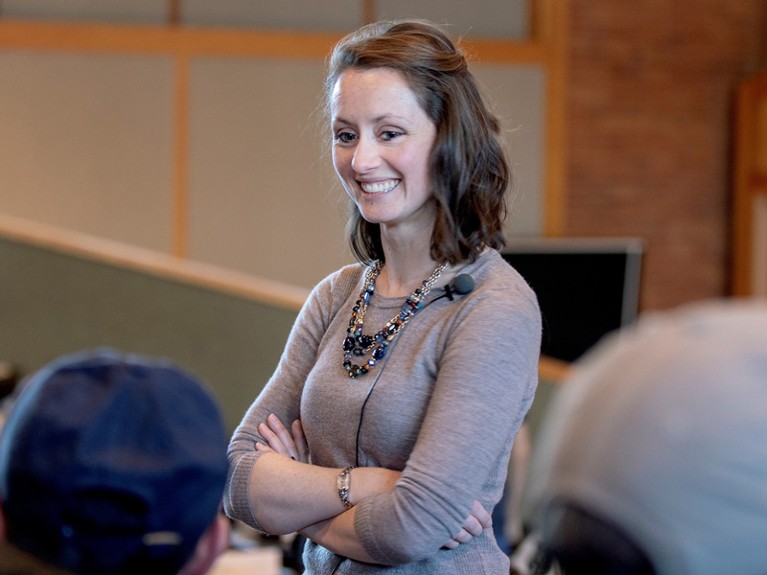
She focused on what she calls “a really extreme form of active learning”, when students invent solutions to problems before being taught the standard methods. It results in “much richer and deeper understanding”, Holmes says.
Tanner’s path, by contrast, started in the biology lab. She earned a PhD in neuroscience at the University of California, San Francisco, in 1997. She then did a postdoc in education research, studying partnerships between scientists and school classrooms. Tanner, who started her professor post at San Francisco State University in 2004, is particularly interested in how teachers and scientists can work together to make classroom biology more like actual biology research.
As her career has advanced, so has the community of researchers who share her passion. At a meeting of the Society for the Advancement of Biology Education Research last July, she saw her former postdocs and graduate students who now have teams of their own.
There are many journals, professional organizations and conferences at which people can start learning about education research (see ‘Resources for science-education researchers’). Social media is beneficial, too, says Manuel João Costa, deputy rector for student affairs and innovations in teaching and learning at the University of Minho in Braga, Portugal. He advises following the social-media accounts of teaching and learning centres, which often post content of interest.
Resources for science-education researchers
Scientists interested in pivoting to the science-education field can get started by reading the literature, attending conferences and joining relevant organizations.
Journals
• Physical Review Physics Education Research
• Journal of Geoscience Education
Professional organizations
• The International Society of the Learning Sciences
• Society for the Advancement of Biology Education Research
• American Association of Physics Teachers
• American Society for Engineering Education
• European Association for Research on Learning and Instruction
Conferences
Physics Education Research Conference in Sacramento, California, 19–20 July 2023
Gordon Research Conferences are small, international meetings at which scientists can discuss research that has not yet been published. Upcoming US events include:
• Undergraduate Biology Education Research in Lewiston, Maine, 25–30 June 2023
• Chemistry Education Research and Practice in Lewiston, Maine, 9–14 July 2023
• Visualization in Science and Education in Lewiston, Maine, 16–21 July 2023
Report
• Reaching Students: What Research Says About Effective Instruction in Undergraduate Science and Engineering (National Academies Press, 2015)
“It’s important to get some professional qualification in this space,” advises Susan Rowland, deputy executive dean for the faculty of science at the University of Queensland in Brisbane, Australia. She gained a graduate certificate in teaching in 2007 as she pivoted towards an education-focused career, and says it helped her to become the first teaching-focused faculty member in the biochemistry department, in 2009. Teaching-specific training also schools researchers in the vocabulary that educators and education scholars use when they communicate and publish their work.
Being the first teaching-focused researcher in her department also meant that Rowland had to work out how to angle for tenure. To prove her worth, she says, it was crucial to operate in the ‘currency’ that other faculty members valued: papers, grants and visible public impact.
Eager educators should also be aware, Rowland adds, that by taking a teaching-focused position, they could be closing the door on a more conventional research-based career.
Seeking status
Perceptions of education and teaching vary, and Tanner has found that many academic deans in California exhibit some bias against education-focused researchers — although they appreciate the grant money these faculty members bring in5. Tanner recalls that numerous people told her that her career path was a waste of her neuroscience training. She says she was “pretty great” at neuroscience research, and that there is no reason to think that other education-minded scientists failed at the bench, either. She has obtained grants, awards and success by following her passions.
In fact, both students and faculty members benefit when education-focused academics are embedded in science departments. These specialists understand their science discipline better than do scholars who trained in education only, and they can serve as formal or informal resources for colleagues who want to improve in the classroom.
“We drive curriculum renewal and best practice in the classroom and online,” says Terry Mulhern, a biomedical-science educator at the University of Melbourne. “We innovate and improve, and in doing so we bring our [department] colleagues with us.” For example, in 2019, he and a colleague revamped their university’s introductory biochemistry course using individualized feedback to students, lessons based on common misconceptions and several online elements. The latter proved useful when the institution had to pivot to full online learning in 2020 as a result of COVID-19 lockdowns.
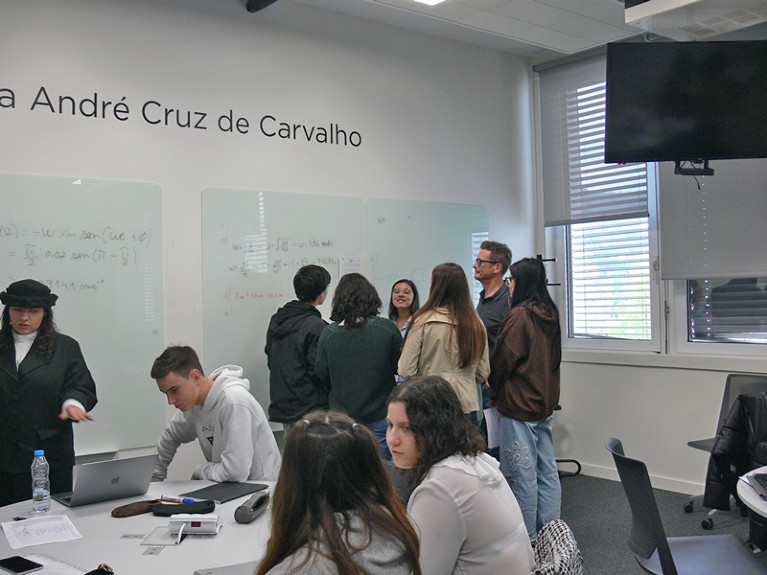
Changing colleagues’ attitudes towards education can take time, as Rowland knows well. When she was first hired to change the culture of teaching in the University of Queensland’s School of Chemistry and Molecular Biosciences, her first move was to choose the undesirable office next to the men’s toilets. Most of the department’s faculty were men, and she knew they’d all have to walk past her door eventually. That’s when she’d call out a cheery “Hi!”
After a while, colleagues started coming in, sitting in her comfortable chairs and talking about their students. Then they’d ask her questions — “You’ve published in PNAS? And in Nature journals? And you’re teaching-focused?” Yes, yes and yes, she’d respond.
Eventually, Rowland says, she earned her peers’ respect. Faculty members would come to her with teaching ideas, and she would help them to choose new approaches to try in their classrooms. “My presence legitimized the idea that they could talk about their courses as works in progress,” she says. The biochemistry department now has 6 teaching-focused academics amid a faculty of 70.Ban the lecture
At Cornell, Holmes says that she isn’t formally expected to help her peers in the physics department to improve their teaching, but she serves as a resource just like any other faculty member with specific expertise. She knows cutting-edge teaching techniques she can implement and share with colleagues. For example, peer instruction is a technique in which lecture students answer a multiple-choice question, confer with their classmates, then answer it again, usually with improved understanding. The method often spreads between faculty members by word of mouth6.
Holmes also brings a fresh perspective to education research, using techniques such as machine learning. For example, a graduate student in her group applied theoretical statistical physics to model the messy data on student behaviours in physics lab courses. Using this technique, the researchers uncovered a gender divide in enquiry-based lab projects, with men more likely to use equipment and women more likely to analyse data7.
All this effort in improving education eventually feeds the research enterprise, says Rui Oliveira, a biochemist and education researcher at the University of Minho. Well-taught undergraduates become capable graduate students and postdocs with critical-thinking skills — just what Wieman was after when he started investigating teaching 35 years ago.
“In the long run,” says Oliveira, “you will get better scientists to work with, and do better science.”
Nature 613, 203-205 (2023)
doi: https://doi.org/10.1038/d41586-022-04509-3
2nd Section GEA 11/1/23: After the likes of Anne Frank, Baruch Spinoza & John Locke let’s get to work now.
“Active learning interventions improve achievement for all students; those with disadvantaged and ethnic-minority backgrounds gain the most6. Administrators and faculty members have a responsibility to ensure that introductory classes do not push students away from STEM courses but promote critical thinking, problem solving, engaged learning and knowledge retention for all students, whether they intend to major in STEM fields or not. Effective STEM teaching is crucial to developing a science-literate population that can address the complex and interdisciplinary health, energy, security and environmental challenges of our time.”
https://rdcu.be/c287J, also Nature, with thanks, this source, Australian readers note it has extensive Australian input
Philosophy of Science students please “unpack” the above statement (as they go in Socratic/ Leninism-Marxism industrial era teaching-methodology or siloised, say, 18th Century neoclassical pedagogy – artificially compartmentalised to maximise pecuniary gain and societal prestige for practitioners – not primarily capital owners but aspirational fiscal accumulators – 18th Century neoclassical pedagogy – or Second Millennium rapine coloniser aristoi “global north” economy generally): deracinated, marketed for cash, kudos and expert-celebrity status, eviscerated, etherised/ evaporated and “stored” at enormous fiscal & global environmental cost as data in the dying days of global dereguatory governance-blind neoliberalism: still early in this third decade of the 21st century
..this the literary-cultural “Big Bang Theory” (USA clever young men demeaning, seconding, sexually capturing & lampooning all females) and “time-travel” era accumulation & compilation of disembodied facts of imagination or conjecture comprehensively, utterly and totally divorced from ecological, even non-household communal reality – a social universe oxymoronic extravaganza that is supposed to pass as entertainment for my grandchildren and yours, reader.
..I’m reminded of the living human culture Jeanette Winterson essays, “Love Objects” 1995, providing me at least with a rather chilling insight into the lives of children in mental-illness manufacturing, disjunctive~~ and frankly psychotic households now proliferating almost exponentially (r-number at least 1.1 likely?) all over the middle- and upper income consumer society world~~
..numbed and nonsensised by historical narrative, celebrity, mythos, hubris, solopsism and exponentially “metastasing” (that is to write in non-emotive non-rhetorical terms proliferating) solecisms, not logos re names, numbers, geolocations & things, let alone considered reflection upon their quantum relations in say four to five set series (my original reads-any-way sequentia quantum-maths I first called trialectics in the context of the historically, technically, morally and intellectually busted post WWII Dialectics of the Damned – Workers vs Capital and Monetary vs Fiscal and Atheists vs Opus Dei to nominate three of the world’s worst-ever psycholinguistic trainwrecks) 1996 – 99 JB SA
Meanwhile here’s your European and American Deep South 1930’s zeitgeist Australian Broad & Bloke Casting Corporation radio seance shoah – we’re here to blow any new technology out of the water – it’s disruptive for goodness sake old chap – and clamp down on the arts, humanities, sociology and your actual marine coastal and terrestrial environmental #science – they’re disruptive of our fabulous earnings from toxic #FossilFuels-burning enterprises that employ thousands, who in turn revel in trickled-down Adam Smith 1776 opulence and go off to live in Denpasar old chap – focussing resolutely on making compendious notes and videos about fairy penguins/ cute anthropomorhised fishies & piggies & stuff ‘cos kids love it, collecting krill and spending 100s of millions on iBeacons & RFIDs instead of doing any critical global heating research (or indeed saying a damned word about it) because this TV & #tourism detritus helps the economy and the kickbacks, junkets, preferments, sinecures, wink-winks, knight-/ damehoods and state awards are fantastic.
Never let it be said we just make stuff up. We’re the fabulists, grinches and electoral autocracy champs Saatchi & Saatchi, Burston Marsela, Crosby Textor, Deloitte, KPMG, @pwc, McKinsey & Co, Jim Reed’s Resolve Strategic, the egregious Steve Bannon – Sarah Ferguson, Englishwoman’s, Cambridge Analytica friend, King & Wood Mallesons, Clayton Utz, the internationally embarrassing 43% carbon emissions reduction in EIGHT years Bellyflop RepuTech, Goldman Sachs, the Institute for Economic Affairs (Britain), the Prince’s Trust (ANU-chancellor Chair Julie Bishop), the wild and raunchy Australian Taxation Office, the 1948 Oxford Union Debating Club with Norman Mailer tackling that wicked woman Julian A.., whoops Germaine Greer, we the hard men & dizzy ladies of #Econometrics and the #Global #Derivatives #Markets and we’re making a complete killing.
So call Lifeline, suckers.
John Blundell. South Australia 11012023
~~ ~~ RD Laing “The Divided Self” originally published 1960 globally popularised among enquiring readers 1971, especially students intent on finding alternatives to basically medieval pills, potions, syringes, surgery Germ & Dettol theory and unquestioned prestigious allopathic medicine in general – our health is ours to nurture, nourish, heal and grow, we were all learning – only the half of it could be supplied by expert services, we knew

 Billionaire-🙈🙊🙉🐒s with Olivettis